Overview
This policy defines how PII retention, deletion, anonymization, de-identification, return, transfer and disposal are governed and evidenced. It applies across controller, joint controller, processor and subprocessor contexts and covers live systems, backups, archives, logs, temporary files, paper records and storage media.
Retention Rules Before Use
Requires documented periods, triggers, owners, justifications, final disposition and review dates in REG02 before approval.
Controlled Final Disposition
Covers deletion, return, transfer, anonymization, de-identification and secure disposal across live data, archives and backups.
Processor Alignment
Requires customer instructions, subprocessor flow-down requirements and final disposition evidence in REG08.
▾ Read Full Overview (click to expand)
Policy Diagram
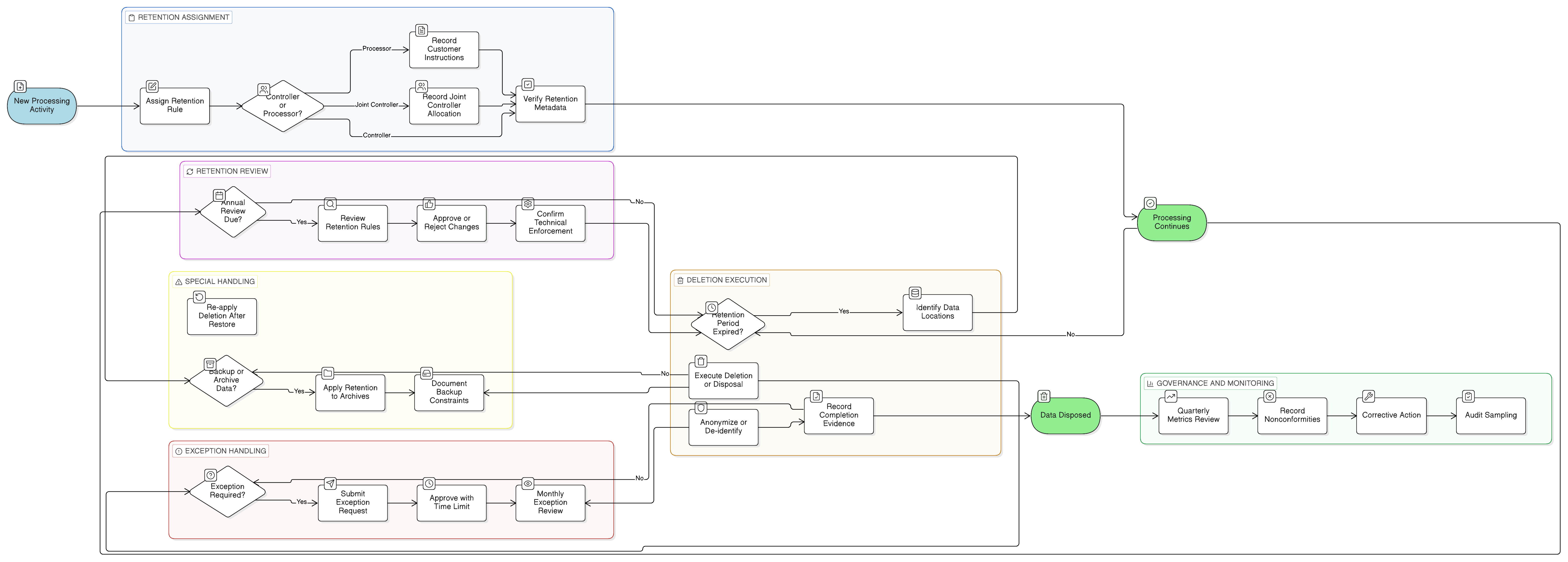
Click diagram to enlarge (open in new tab for full size)
What's Inside
Retention rule ownership and required metadata
Deletion, return, transfer and disposal execution
Backups, archives, replicas, logs and temporary files
Anonymization, de-identification and retention minimization
Exceptions, nonconformities and corrective action
Metrics, audit sampling and policy maintenance
Framework Compliance
🛡️ Supported Standards & Frameworks
This product is aligned with the following compliance frameworks, with detailed clause and control mappings.
| Framework | Covered Clauses / Controls |
|---|---|
| ISO/IEC 29100:2020 |
Clause 5.5Clause 5.6Clause 5.10
|
| ISO/IEC 29151:2022 |
Annex A.7Annex A.7.2
|
| EU GDPR |
Article 5(1)(e)Article 5(2)Article 17Article 24Article 26Article 28Article 30Article 32
|
| ISO/IEC 27701:2025 |
Clause 7.5Clause 8.1Clause 9.1Clause 10.2Annex A.1.2.8Annex A.1.2.9Annex A.1.3.7Annex A.1.3.8Annex A.1.4.6Annex A.1.4.7Annex A.1.4.8Annex A.1.4.9Annex A.2.2.2Annex A.2.2.3Annex A.2.2.7Annex A.2.3.2Annex A.2.4.2Annex A.2.4.3Annex A.3.20Annex A.3.21Annex A.3.24
|
| ISO/IEC 27555:2025 |
Clause 5.1Clause 5.2Clause 5.3Clause 5.4Clause 5.5Clause 5.6Clause 5.8Clause 7.2Clause 7.3Clause 8.3Clause 9.1Clause 9.2Clause 9.3Clause 9.4Clause 9.5Clause 9.6Clause 9.7Clause 10.1Clause 10.2Clause 10.3
|
| ISO/IEC 27557:2022 |
Clause 4Clause 5.2Clause 5.3Clause 5.4.1
|
| ISO/IEC 27002:2022 |
Related Policies
Principal Rights Management Policy
Approved erasure requests trigger deletion assessment in REG06 and REG02 under this retention policy.
Processor, Subprocessor and Third-Party Privacy Management Policy
Processor, subprocessor and third-party return, transfer, deletion and disposal evidence is managed through REG08.
Security and Access Control Policy
Secure disposal method classes, storage media handling and technical enforcement depend on security controls.
Incident and Breach Management Policy
Retention, deletion or disposal failures that meet PII incident criteria require REG10 handling.
PIMS Monitoring, Audit and Improvement Policy
Retention metrics, evidence sampling, nonconformities and corrective actions are integrated with monitoring and improvement.
Processing Inventory and Lawful Basis Policy
Retention rules and final disposition metadata are recorded in the PII Processing Inventory / ROPA.
About Clarysec Policies - PII Retention, Deletion and Disposal Policy
The PII Retention, Deletion and Disposal Policy turns storage limitation into an auditable operating model. It requires retention rules to be defined before processing begins, recorded in REG02, aligned with controller or customer instructions, and reviewed at least annually or after material change. The policy covers deletion, return, transfer, anonymization, de-identification and secure disposal across live systems, archives, backup copies, replicas, logs, staging areas, temporary files, paper records and storage media. It also defines governance roles, processor and subprocessor evidence requirements, exception handling in REG12, incident escalation through REG10 where applicable, and metric-driven monitoring for continual improvement.
Defined Retention Metadata
Requires period, trigger, owner, justification, final disposition and next review date before approval.
Secure Disposal Controls
Requires approved disposal method classes before reuse, release, destruction or external disposal of PII media.
Backup and Archive Handling
Applies retention rules to archives and documents backup windows, restoration handling and technical constraints.
Vendor Evidence
Requires processor, subprocessor and external service evidence for return, transfer, deletion and disposal actions.
Exception Governance
Requires time-bound approved exceptions with owners, expiry dates, compensating controls and monthly review.
Frequently Asked Questions
Built for Leaders, By Leaders
This policy was authored by a security leader with 25+ years of experience deploying and auditing ISMS frameworks for global enterprises. It's designed not just to be a document, but a defensible framework that stands up to auditor scrutiny.
Authored by an expert holding:
Coverage & Topics
🏢 Target Departments
🏷️ Topic Coverage
This policy is 1 of 25 in the Complete ISO/IEC 27701 PIMS Pack
Save 52%Get all 25 PIMS policies, full registers set and detailed implementation plan for €799, instead of €1,675 if purchased individually.
View Complete 27701 Pack →