Overview
This policy defines how PII incidents and breaches are reported, assessed, contained, notified, documented, closed, and improved. It uses REG10 as the primary incident register and links records to processing, risk, supplier, transfer, training, audit, and corrective-action evidence.
Structured Breach Response
Defines intake, triage, assessment, containment, notification, closure, and improvement requirements for PII incidents and breaches.
Audit-Ready Evidence
Uses REG10 as the primary incident register and links evidence to processing, risk, supplier, transfer, training, and corrective-action records.
Role-Based Accountability
Assigns clear responsibilities to Privacy, Security, Incident Response, system, process, vendor, audit, and Top Management roles.
▾ Read Full Overview (click to expand)
Policy Diagram
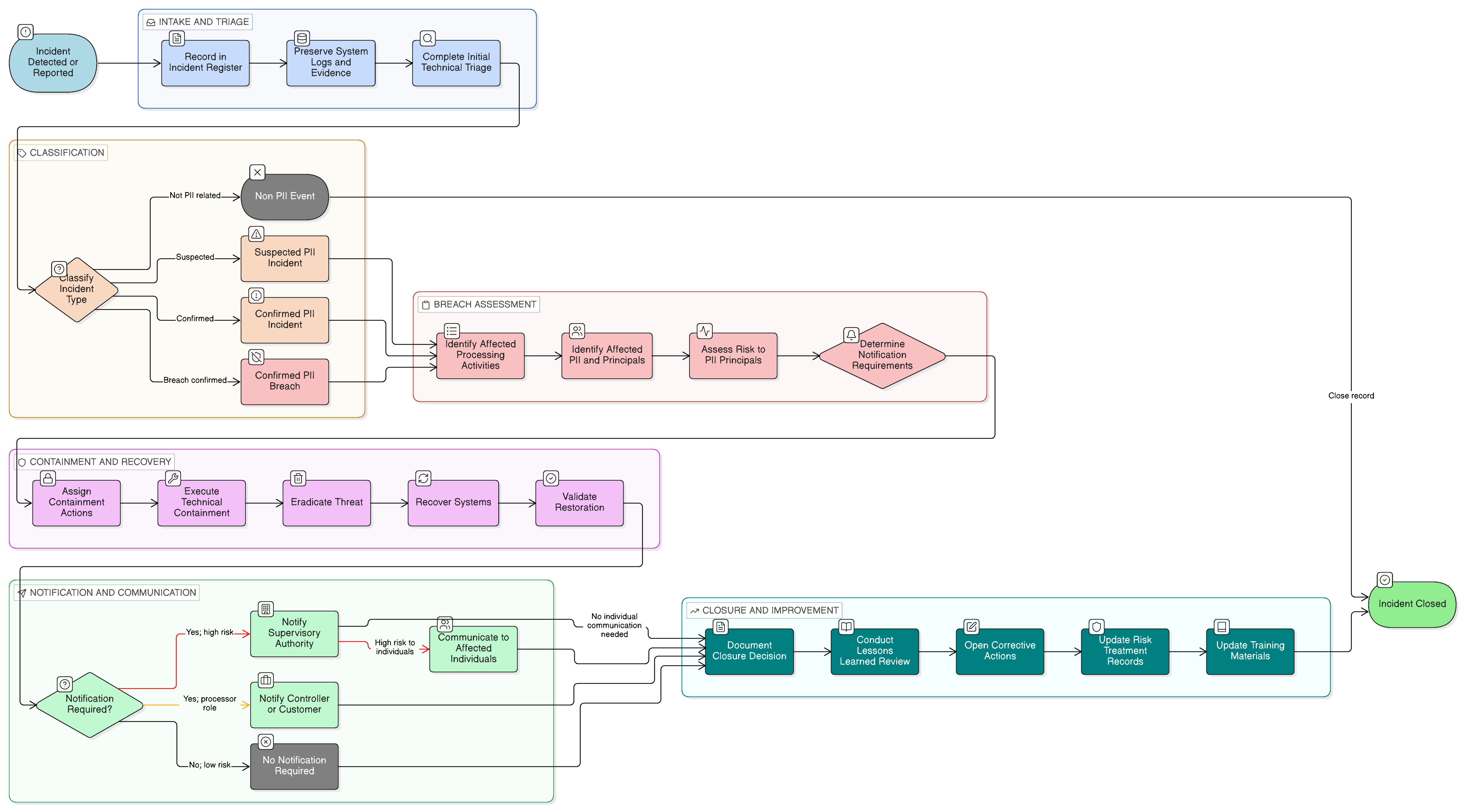
Click diagram to enlarge (open in new tab for full size)
What's Inside
Scope, definitions, and applicability rules
REG10 incident and breach register requirements
Classification and breach assessment criteria
Containment, eradication, recovery, and validation
Notification, communications, and recordkeeping
Lessons learned, metrics, audit, and continual improvement
Framework Compliance
🛡️ Supported Standards & Frameworks
This product is aligned with the following compliance frameworks, with detailed clause and control mappings.
| Framework | Covered Clauses / Controls |
|---|---|
| ISO/IEC 27701:2025 |
Clause 7.4Clause 7.5Clause 8.1Clause 8.2Clause 8.3Clause 9.1Clause 10.2Annex A.3.11Annex A.3.12Annex A.3.13Annex A.3.14Annex A.2.2.2Annex A.2.2.6
|
| EU GDPR |
Article 5(2)Article 24Article 26Article 28Article 32Article 33Article 34Article 39
|
| ISO/IEC 29100:2020 |
Clause 5.11Clause 5.12
|
| ISO/IEC 29151:2022 |
Clause 16.1.2Clause 16.1.3
|
| ISO/IEC 27002:2022 | |
| ISO/IEC 27035-1:2023 |
Clause 5.2Clause 5.3Clause 5.4Clause 5.5Clause 5.6
|
| ISO/IEC 27035-2:2023 |
Clause 4Clause 6Clause 10Clause 11Clause 12
|
| ISO/IEC 27035-3:2020 |
Clause 7Clause 8Clause 9Clause 10Clause 11Clause 12
|
| ISO/IEC 27018:2020 |
Annex A.10.1
|
| NIS2 Directive (EU) 2022/2555 |
Article 23
|
| DORA Regulation (EU) 2022/2554 |
Article 17Article 18Article 19
|
Related Policies
Processing Inventory and Lawful Basis Policy
Incident assessment depends on identifying affected processing activities, PII categories, PII principals, purposes, and systems.
Privacy Risk Assessment and DPIA Policy
Breach assessment and post-incident improvement rely on privacy risk, DPIA, residual risk, and risk treatment linkage.
Processor, Subprocessor and Third-Party Privacy Management Policy
The incident process requires coordination with processors, subprocessors, suppliers, customers, and other third parties.
International Transfer Policy
Incidents affecting cross-border processing must be linked to transfer locations and international transfer records.
Security and Access Control Policy
Technical triage, containment, eradication, recovery, and evidence preservation depend on security and access controls.
PIMS Monitoring, Audit and Improvement Policy
Lessons learned, corrective actions, audit review, management review, and continual improvement are core closure outputs.
About Clarysec Policies - PII Incident and Breach Management Policy
This policy establishes an operational PIMS framework for managing PII incidents and breaches from intake through closure and improvement. It defines responsibilities for Top Management, the Privacy Lead / PIMS Manager, Data Protection Officer / Privacy Advisor, Incident Response Coordinator, Information Security Lead, System Owner / Application Owner, Process Owner / Business Owner, Vendor / Procurement Owner, and Internal Audit / Compliance Reviewer. The policy uses REG10 as the primary PII Incident and Breach Register and links incidents to evidence objects including REG01, REG02, REG03, REG04, REG08, REG09, REG11, and REG12. It supports controller, joint controller, processor, and subprocessor contexts by requiring role-specific breach assessment, notification, communications, evidence preservation, corrective action, metrics, audit, and management review.
REG10-Centered Workflow
Uses REG10 as the primary register for incident facts, classification, decisions, actions, notifications, evidence, and closure.
Controller and Processor Rules
Separates controller, joint controller, processor, and subprocessor obligations for assessment, notification, and communication.
Defined Response Roles
Assigns duties across privacy, security, incident response, system, process, vendor, audit, and Top Management functions.
Continuous Improvement Linkage
Requires lessons learned, corrective actions, metrics, internal audit, and management review for incident-management effectiveness.
Frequently Asked Questions
Built for Leaders, By Leaders
This policy was authored by a security leader with 25+ years of experience deploying and auditing ISMS frameworks for global enterprises. It's designed not just to be a document, but a defensible framework that stands up to auditor scrutiny.
Authored by an expert holding:
Coverage & Topics
🏢 Target Departments
🏷️ Topic Coverage
This policy is 1 of 25 in the Complete ISO/IEC 27701 PIMS Pack
Save 52%Get all 25 PIMS policies, full registers set and detailed implementation plan for €799, instead of €1,675 if purchased individually.
View Complete 27701 Pack →