policy ISO 27701 PIMS Policy Pack

PII Processing Inventory and Lawful Basis Policy

Maintain an audit-ready PII processing inventory with lawful basis, ROPA, risk, retention, transfer, and processor linkage controls.

Overview

This policy establishes REG02 as the authoritative PII processing inventory and ROPA record. It requires documented purposes, lawful basis or customer instructions, PII categories, recipients, retention, transfers, risk/DPIA linkage, reviews, exceptions, and corrective action evidence before and during PII processing.

Audit-Ready ROPA Evidence

Establishes REG02 as the authoritative inventory for PII processing activities, roles, purposes, categories, status, and review evidence.

Lawful Basis Before Processing

Requires controller lawful basis validation and processor customer instruction records before new or changed processing begins.

Clear Ownership and Linkage

Assigns process, system, privacy, vendor, audit, and management responsibilities across REG02, REG08, REG12, and related records.

Read Full Overview (click to expand)
The PII Processing Inventory and Lawful Basis Policy defines how an organization maintains its PII Processing Inventory / ROPA and documents the core facts needed to demonstrate accountable processing within the PIMS scope. It applies to all in-scope PII processing activities, including processing performed as a controller, joint controller, processor, or subprocessor. The policy covers processing by business processes, systems, applications, suppliers, processors, subprocessors, and data-sharing recipients, and it applies to new, materially changed, and retired processing. A processing inventory record is defined as a REG02 entry that describes a distinct PII processing activity, including its purpose, role, owner, PII categories, PII principal categories, lawful basis or customer instruction reference, systems, recipients, retention reference, transfer reference, privacy risk status, and review status. A central objective of the policy is to make REG02 the authoritative evidence object for the PII processing inventory and records of processing activities. The policy requires a Process Owner or Business Owner to create a REG02 record before any new PII processing begins and to record the required fields before the activity starts. It also requires the organization’s PIMS role to be classified for each activity, and it links systems, applications, vendors, processors, subprocessors, third-party sharing, and joint controller relationships to the relevant REG02 record. This creates a structured record of processing that can connect to privacy notices, consent, DPIA, risk, supplier, transfer, control, and audit evidence where applicable. For controller activities, the policy requires the specific processing purpose to be documented before PII is collected, used, disclosed, or otherwise processed. The Privacy Lead / PIMS Manager must validate the lawful basis recorded in REG02 before controller processing begins and before any purpose change takes effect. The policy also addresses special situations: consent must link to REG05, legitimate interests must reference REG04, special category PII requires a recorded condition, and criminal conviction or offence data requires an authorization basis. For processor and subprocessor contexts, the policy requires customer instruction references, customer purpose, subject matter, duration, PII categories, and PII principal categories to be recorded before processing begins, with agreement and instruction evidence maintained in REG08. The policy also defines how the inventory remains current. Material processing changes include changes to purpose, lawful basis, PIMS role, PII category, PII principal category, recipient, system, supplier, subprocessor, processing location, transfer, retention rule, security classification, privacy notice, consent dependency, DPIA status, customer instruction, or certification scope. REG02 must be updated within 10 business days of identifying such a change, and privacy risk and DPIA screening must be initiated in REG04 before new or materially changed processing proceeds. The Privacy Lead / PIMS Manager reconciles REG02 against REG01, REG03, REG04, REG08, and REG09 quarterly, while Internal Audit / Compliance Reviewers sample completeness, accuracy, and currency during scheduled reviews. Governance, measurement, exceptions, and enforcement are built into the policy. The Privacy Lead / PIMS Manager submits quarterly inventory health summaries in REG12, records inventory metrics, validates new REG02 records, and maintains minimum field and review cadence rules. Top Management reviews completeness, overdue reviews, major lawful basis issues, and unresolved nonconformities during management review. Exceptions must be requested and assessed in REG12, with expiry dates not exceeding 90 days, and certain exceptions require advice from the Data Protection Officer / Privacy Advisor and approval by Top Management. Enforcement includes recording nonconformities, suspending new processing when evidence is missing, blocking system go-live or supplier onboarding when required linkage is absent, and verifying corrective action effectiveness.

Policy Diagram

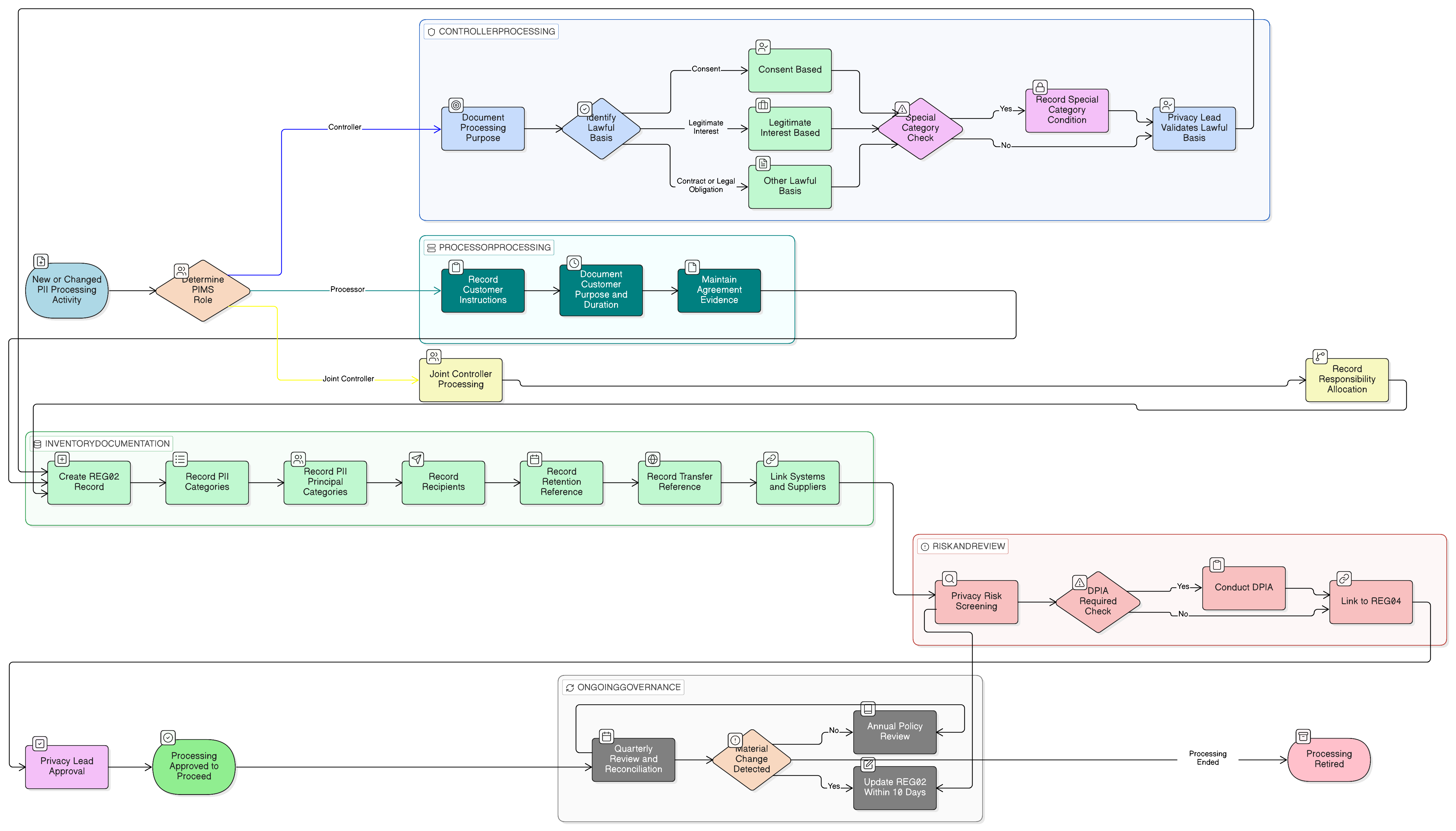
Process-flow diagram showing creation of a REG02 PII processing record before processing, validation of lawful basis or customer instruction, linkage to systems, suppliers, notices, consent, retention, transfers and DPIA screening, quarterly reconciliation and audit review, and exception or nonconformity handling in REG12.

Click diagram to enlarge (open in new tab for full size)

What's Inside

REG02 Processing Inventory and ROPA Requirements

Controller Purpose and Lawful Basis Records

Processor, Subprocessor and Joint Controller Records

PII Categories, Recipients, Retention and Transfers

Inventory Change, Review and DPIA Screening Linkage

Exceptions, Enforcement and Corrective Action Evidence

Framework Compliance

🛡️ Supported Standards & Frameworks

This product is aligned with the following compliance frameworks, with detailed clause and control mappings.

Framework Covered Clauses / Controls
ISO/IEC 27701:2025
Clause 4.1Clause 6.1.2Clause 6.1.3Clause 7.5Clause 8.1Clause 8.2Clause 9.1Clause 10.2Annex A.1.2.2Annex A.1.2.3Annex A.1.2.6Annex A.1.2.8Annex A.1.2.9Annex A.2.2.2Annex A.2.2.3Annex A.2.2.7
EU GDPR
Article 5(1)(a)Article 5(1)(b)Article 5(1)(c)Article 5(1)(e)Article 5(2)Article 6Article 9Article 10Article 24Article 26Article 28Article 30Article 35
ISO/IEC 29100:2020
Clause 5.3Clause 5.4Clause 5.5Clause 5.6Clause 5.10
ISO/IEC 29151:2022
Annex A.3Annex A.4Annex A.5Annex A.7
ISO/IEC 29134:2020
Clause 5.1Clause 6.2

Related Policies

Privacy Notice and Transparency Policy

REG02 must link to privacy notice evidence before controller processing is externally communicated or launched.

Consent and Preference Management Policy

Controller processing that relies on consent must link REG02 to REG05 before processing begins.

Privacy Risk Assessment and DPIA Policy

New or materially changed processing must trigger privacy risk and DPIA screening in REG04.

Retention, Deletion and Disposal Policy

Each processing activity must record a retention rule or retention reference in REG02.

Processor, Subprocessor and Third-Party Privacy Management Policy

Processor, subprocessor, third-party sharing, and joint controller relationships must link REG02 with REG08.

International Transfer Policy

REG02 must link to REG09 before any international PII transfer begins.

About Clarysec Policies - PII Processing Inventory and Lawful Basis Policy

This policy operationalizes the PII processing inventory and lawful basis requirements within a Privacy Information Management System. It defines REG02 as the authoritative inventory and ROPA evidence object for distinct PII processing activities and requires each record to document purpose, PIMS role, owner, PII categories, PII principal categories, lawful basis or customer instruction reference, systems, recipients, retention reference, transfer reference, privacy risk status, and review status. It supports controller, joint controller, processor, and subprocessor contexts by linking REG02 with supporting evidence objects such as REG04 for privacy risk and DPIA screening, REG05 for consent, REG07 for privacy notices, REG08 for supplier and processor relationships, REG09 for international transfers, and REG12 for approvals, reviews, exceptions, metrics, and nonconformities.

Authoritative Inventory

Defines REG02 as the single inventory and ROPA evidence object for in-scope PII processing activities.

Pre-Processing Controls

Requires purpose, lawful basis, customer instruction, role, and key inventory fields before processing begins.

Change and Risk Linkage

Connects material processing changes to REG04 privacy risk and DPIA screening before processing proceeds.

Role-Based Accountability

Assigns responsibilities to privacy, business, system, vendor, audit, and top management roles.

Frequently Asked Questions

Built for Leaders, By Leaders

This policy was authored by a security leader with 25+ years of experience deploying and auditing ISMS frameworks for global enterprises. It's designed not just to be a document, but a defensible framework that stands up to auditor scrutiny.

Authored by an expert holding:

MSc Cyber Security, Royal Holloway UoL CISM CISA ISO 27001:2022 Lead Auditor & Implementer CEH

Coverage & Topics

🏢 Target Departments

Privacy Legal Compliance IT Security Audit

🏷️ Topic Coverage

Privacy Information Management Personal Data Processing Records of Processing Consent and Lawful Basis Privacy Impact Assessment International Data Transfers Controller and Processor Responsibilities
€49

One-time purchase

Instant download
Lifetime updates

This policy is 1 of 25 in the Complete ISO/IEC 27701 PIMS Pack

Save 52%

Get all 25 PIMS policies, full registers set and detailed implementation plan for €799, instead of €1,675 if purchased individually.

View Complete 27701 Pack →

PII Processing Inventory and Lawful Basis Policy

Product Details

Type: policy
Category: ISO 27701 PIMS Policy Pack
Standards: 5