Overview
This policy defines PII-specific security and access controls for systems, services, devices, cloud environments and processes. It covers access, authentication, privileged access, encryption, logging, configuration, vulnerability, endpoint and cloud controls, with evidence linked to REG02, REG08, REG10 and REG12.
PII Security Baseline
Defines PII-specific security requirements for systems, services, devices, cloud environments and operational processes.
Controlled PII Access
Requires approved roles, business-purpose approval, access reviews and fast removal of unsupported or unnecessary PII access.
Evidence-Linked Assurance
Connects access, logging, vulnerability, configuration and exception evidence to REG02, REG08, REG10 and REG12.
Processor Boundaries
Records customer instructions, processor commitments, subprocessor access and cloud shared-responsibility boundaries.
▾ Read Full Overview (click to expand)
Policy Diagram
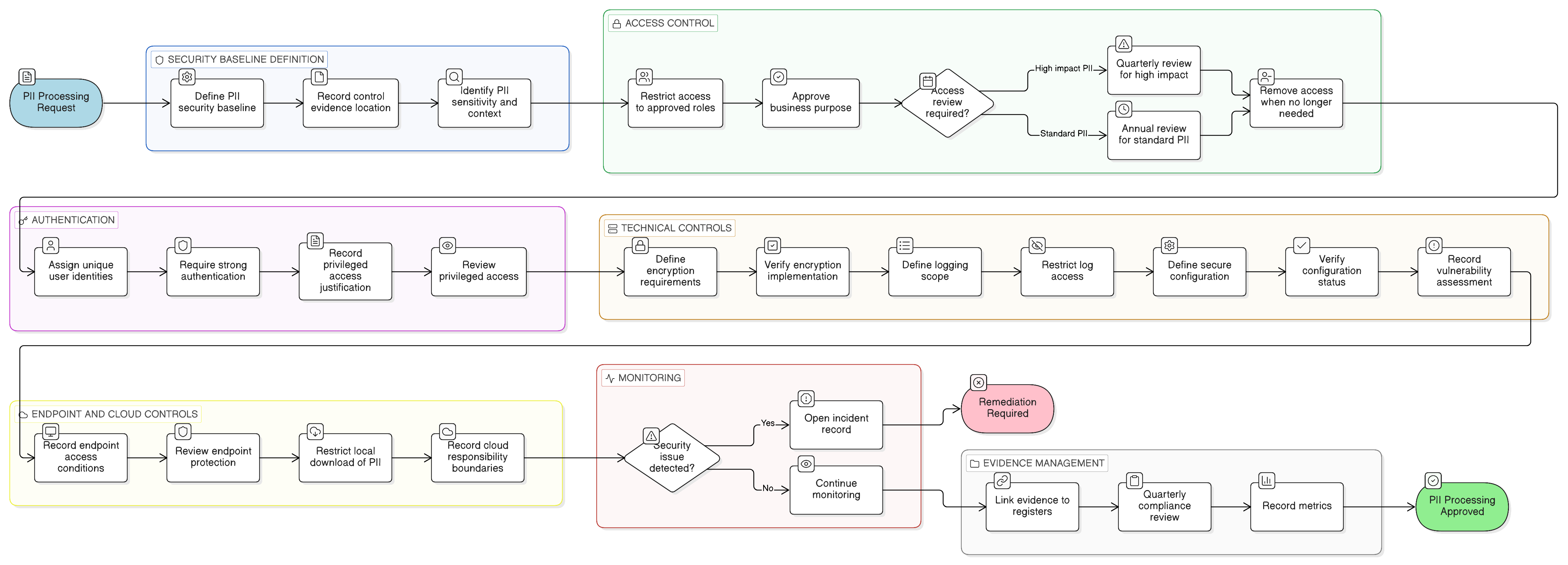
Click diagram to enlarge (open in new tab for full size)
What's Inside
PII security baseline and ISMS integration
Access control and privileged access reviews
Authentication and account exception requirements
Encryption, secure storage, logging and monitoring
Secure configuration, vulnerability, endpoint and cloud controls
REG02, REG08, REG10 and REG12 evidence linkage
Framework Compliance
🛡️ Supported Standards & Frameworks
This product is aligned with the following compliance frameworks, with detailed clause and control mappings.
| Framework | Covered Clauses / Controls |
|---|---|
| ISO/IEC 27701:2025 |
Clause 6.1.3Clause 8.1Clause 7.5Clause 9.1Clause 10.2Annex A.3.8Annex A.3.9Annex A.3.22Annex A.3.23Annex A.3.25Annex A.3.26Annex A.3.28Annex A.3.29Annex A.3.14Annex A.3.15Annex A.3.16
|
| EU GDPR |
Article 5(1)(f)Article 5(2)Article 24Article 28Article 32
|
| ISO/IEC 27001:2022 | |
| ISO/IEC 27002:2022 | |
| ISO/IEC 29100:2020 |
Clause 5.11Clause 5.12
|
| ISO/IEC 29151:2022 |
Clause 9.4.2Clause 9.4.3Clause 9.4.4Clause 9.4.5Clause 10.1.2Clause 10.1.3Clause 12.1.5Clause 18.1.5Clause 18.2.2Clause 18.2.3Clause 18.2.4
|
Related Policies
Processing Inventory and Lawful Basis Policy
PII access approvals depend on recorded processing context, sensitivity and business access needs.
Privacy Risk Assessment and DPIA Policy
Risk and DPIA outcomes inform the level of PII security, authentication, encryption and exception review required.
Processor, Subprocessor and Third-Party Privacy Management Policy
Processor and subprocessor security responsibilities, access boundaries and evidence are recorded through REG08.
Incident and Breach Management Policy
Suspected unauthorized access, disclosure, compromise or PII loss must be opened or linked as REG10 incident records.
PIMS Documented Information and Evidence Management Policy
The policy relies on traceable documented evidence in REG02, REG08, REG10 and REG12 for audit readiness.
PIMS Monitoring, Audit and Improvement Policy
PII security evidence, access reviews, logging and configuration evidence are sampled and reviewed through PIMS oversight.
About Clarysec Policies - PII Security and Access Control Policy
The PII Security and Access Control Policy establishes PII-specific security and access control requirements within the Privacy Information Management System. It connects processing context, access need, processor responsibilities, security findings and implementation evidence to REG02, REG08, REG10 and REG12. The policy applies to controller, joint controller, processor and subprocessor contexts and defines requirements for access control, authentication, privileged access, encryption, logging, secure configuration, vulnerability management, endpoint controls and cloud access boundaries. It supports auditable PIMS assurance by requiring evidence to be recorded, linked, reviewed and maintained without replacing existing information security policies.
PII-Specific Control Scope
Covers systems, applications, services, devices, cloud environments and processes that handle or protect PII.
Clear Role Accountability
Assigns responsibilities to privacy, security, system, process, vendor, incident response and audit roles.
Review Cadence Defined
Sets monthly, quarterly, annual and event-driven reviews for access, privileged access, evidence and baselines.
Canonical Evidence Model
Uses REG02, REG08, REG10 and REG12 as the auditable evidence objects for PIMS assurance.
Frequently Asked Questions
Built for Leaders, By Leaders
This policy was authored by a security leader with 25+ years of experience deploying and auditing ISMS frameworks for global enterprises. It's designed not just to be a document, but a defensible framework that stands up to auditor scrutiny.
Authored by an expert holding:
Coverage & Topics
🏢 Target Departments
🏷️ Topic Coverage
This policy is 1 of 25 in the Complete ISO/IEC 27701 PIMS Pack
Save 52%Get all 25 PIMS policies, full registers set and detailed implementation plan for €799, instead of €1,675 if purchased individually.
View Complete 27701 Pack →