Overview
This policy defines how privacy risk assessments and DPIAs are screened, performed, treated, approved, reviewed, and evidenced. It centers evidence in REG04, links to supporting registers, and sets requirements for high-risk controller processing, processor DPIA assistance, residual risk approval, prior consultation, monitoring, exceptions, and enforcement.
Risk-Based DPIA Control
Defines screening, full DPIA triggers, treatment, residual risk approval, and consultation decisions before high-risk processing proceeds.
Evidence-Driven Governance
Requires REG04 privacy risk and DPIA records linked to REG02, REG03, REG08, REG10, REG11, and REG12 evidence.
Clear Role Accountability
Assigns actions to business, privacy, security, system, vendor, audit, DPO or privacy advisor, and Top Management roles.
▾ Read Full Overview (click to expand)
Policy Diagram
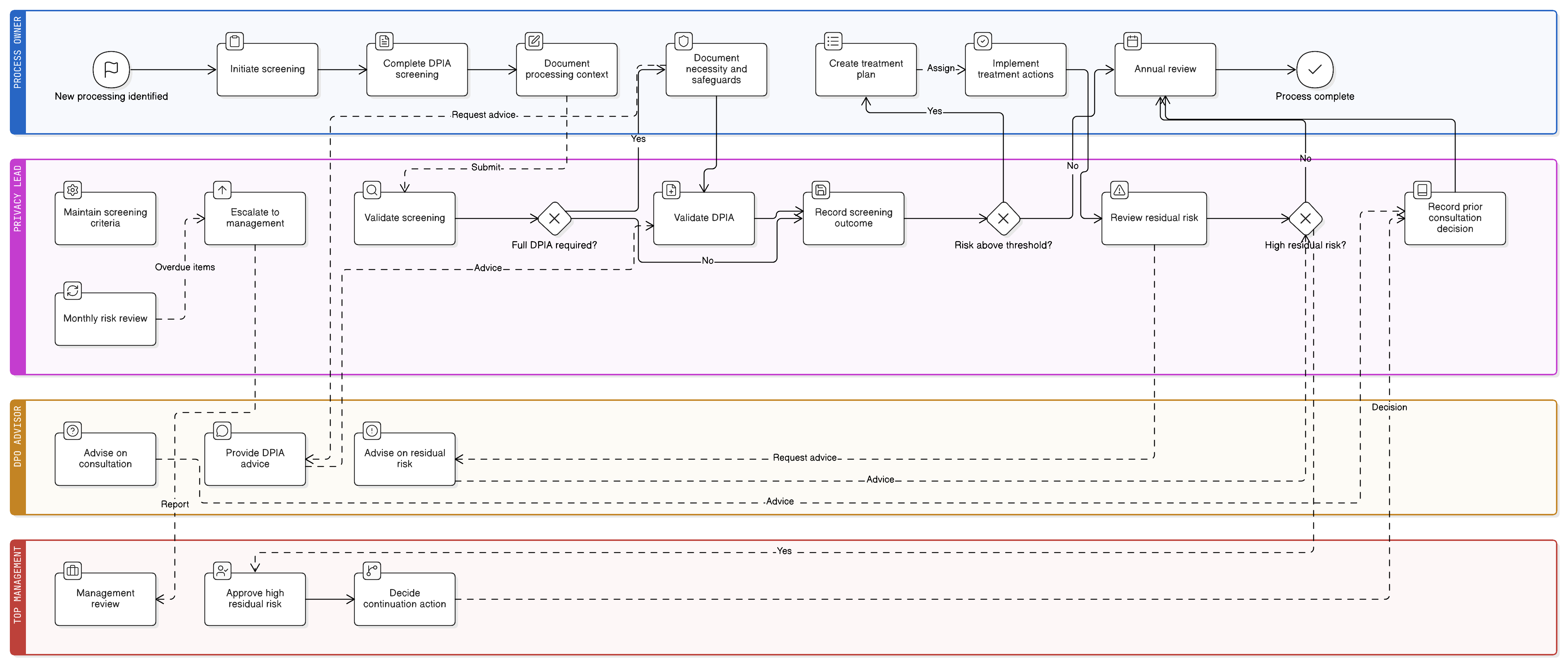
Click diagram to enlarge (open in new tab for full size)
What's Inside
Privacy risk screening criteria and DPIA triggers
Full DPIA execution and approval requirements
Risk treatment plans and residual risk acceptance
Prior consultation decision and escalation process
REG04 evidence management and supporting registers
Monitoring, metrics, exceptions, and enforcement
Framework Compliance
🛡️ Supported Standards & Frameworks
This product is aligned with the following compliance frameworks, with detailed clause and control mappings.
| Framework | Covered Clauses / Controls |
|---|---|
| ISO/IEC 27701:2025 |
Clause 6.1.1Clause 6.1.2Clause 6.1.3Clause 6.3Clause 7.5Clause 8.1Clause 8.2Clause 8.3Clause 9.1Clause 9.3Clause 10.2Annex A.1.2.6Annex A.1.2.9Annex A.2.2.2Annex A.2.2.6
|
| EU GDPR |
Article 5(2)Article 24Article 25Article 28Article 30Article 32Article 35Article 36Article 39
|
| ISO/IEC 29100:2020 |
Clause 4.7Clause 5.11Clause 5.12
|
| ISO/IEC 29134:2020 |
Clause 1Clause 5.1Clause 6.2Clause 6.3
|
| ISO/IEC 29151:2022 |
Clause 4.1Clause 4.2
|
| ISO/IEC 27557:2022 |
Clause 4Clause 5.2Clause 5.3Clause 6.4Clause 6.5Clause 6.6Clause 6.7
|
Related Policies
Processing Inventory and Lawful Basis Policy
REG02 processing inventory records provide required inputs for REG04 privacy risk assessment and DPIA evidence.
Privacy by Design and Default Policy
Privacy-by-design and privacy-by-default inputs are required before go-live approval for systems processing PII.
Processor, Subprocessor and Third-Party Privacy Management Policy
Supplier, processor, subprocessor, data-sharing, and customer DPIA assistance evidence is maintained through REG08 and REG04.
International Transfer Policy
New international transfers are material changes that require privacy risk re-screening in REG04 before they begin.
Security and Access Control Policy
PII security control inputs and treatment status in REG03 support privacy risk treatment approval and monitoring.
PIMS Monitoring, Audit and Improvement Policy
Privacy risk, DPIA evidence, audit findings, corrective actions, and management review outputs are reported and reviewed in REG12.
About Clarysec Policies - Privacy Risk Assessment and DPIA Policy
Privacy governance fails when it is treated as a set of disconnected notices, forms, and legal statements. Effective ISO/IEC 27701 implementation requires a Privacy Information Management System that connects PII processing, lawful basis, controller and processor roles, privacy risk, DPIAs, evidence, monitoring, and continual improvement. This policy defines an operational process for privacy risk assessment and DPIA management. It requires screening before new or materially changed PII processing, full DPIAs for high-risk controller processing, documented processor DPIA assistance where required, risk treatment planning, residual risk acceptance, prior consultation decisions, and recurring review. Each requirement is written as a numbered, auditable clause and tied to evidence objects such as REG02, REG03, REG04, REG08, REG10, REG11, and REG12. The structure supports controller, joint controller, processor, and subprocessor contexts, helping organizations demonstrate accountable, risk-based, and evidence-driven management of PII processing across the PIMS lifecycle.
Pre-Processing Screening
Requires REG04 screening before new or materially changed PII processing recorded in REG02 begins.
DPIA Decision Evidence
Documents full-DPIA decisions, controller high-risk processing rationale, and DPO or privacy advisor advice in REG04.
Defined Owners
Assigns privacy, business, security, system, vendor, incident, audit, and Top Management responsibilities.
Residual Risk Oversight
Requires Top Management approval before high residual privacy risk processing begins or continues.
Monitoring and Review
Sets monthly, quarterly, annual, audit, and management review checkpoints for risks, DPIAs, and treatment actions.
Frequently Asked Questions
Built for Leaders, By Leaders
This policy was authored by a security leader with 25+ years of experience deploying and auditing ISMS frameworks for global enterprises. It's designed not just to be a document, but a defensible framework that stands up to auditor scrutiny.
Authored by an expert holding:
Coverage & Topics
🏢 Target Departments
🏷️ Topic Coverage
This policy is 1 of 25 in the Complete ISO/IEC 27701 PIMS Pack
Save 52%Get all 25 PIMS policies, full registers set and detailed implementation plan for €799, instead of €1,675 if purchased individually.
View Complete 27701 Pack →