Overview
The Cloud PII Processor Policy defines how cloud PII processing must be controlled when the organization acts as a processor or subprocessor. It covers customer instructions, shared responsibility, tenant isolation, subprocessors, transfers, deletion, breach support, audits and evidence across REG02, REG03, REG08, REG09, REG10 and REG12.
Cloud Processor Control
Defines mandatory privacy requirements for SaaS, PaaS, IaaS, hosted, managed cloud, storage, analytics and infrastructure PII processing.
Instruction-Led Processing
Requires customer or upstream processor instructions to be recorded, reviewed and followed before cloud PII processing begins.
Subprocessor Governance
Covers cloud subprocessor authorization, flow-down obligations, locations, change notices, monitoring and exit evidence.
Exit Evidence Ready
Requires return, transfer, deletion, disposal and subprocessor exit evidence for live systems, backups, logs and support copies.
▾ Read Full Overview (click to expand)
Policy Diagram
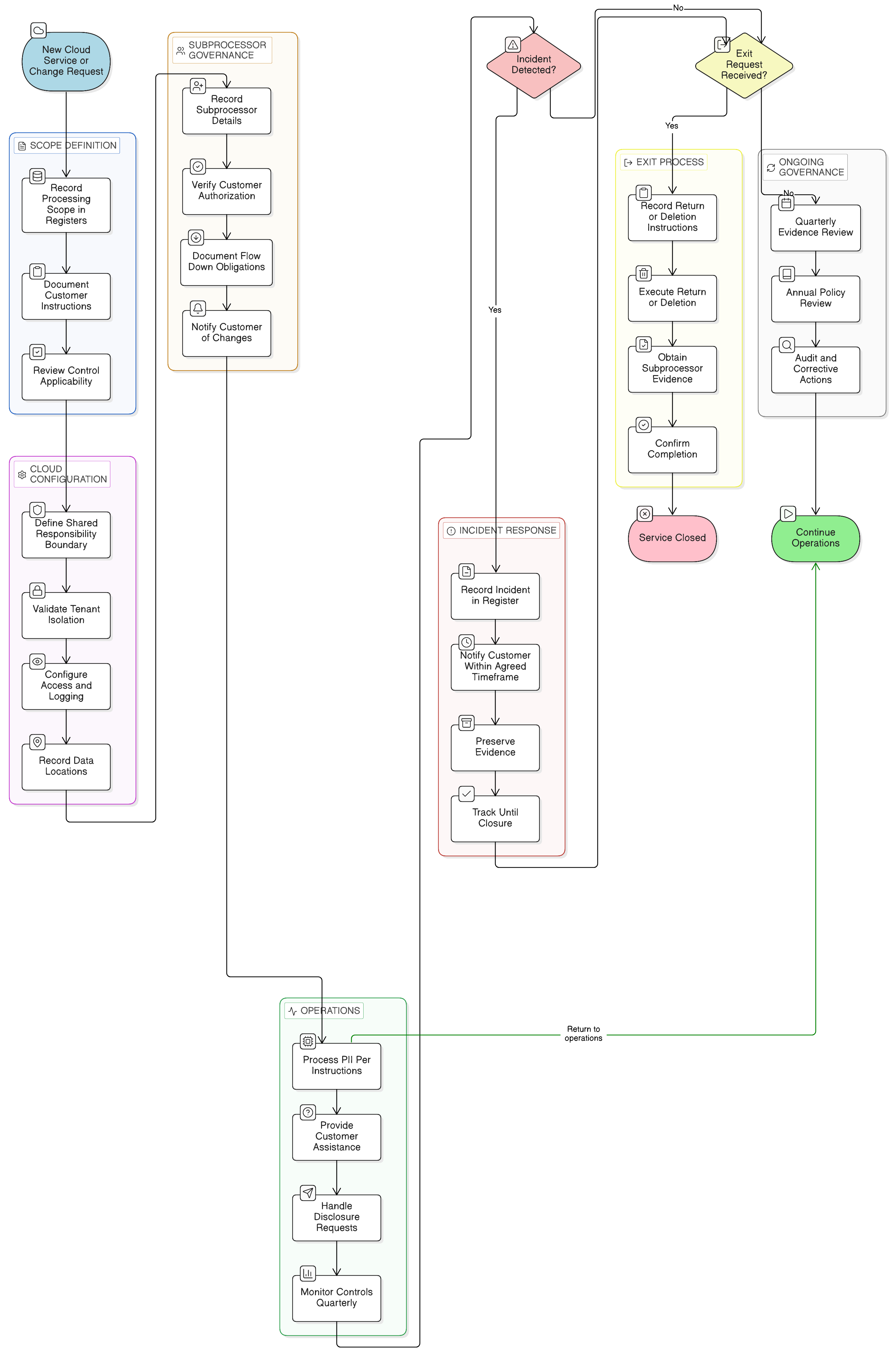
Click diagram to enlarge (open in new tab for full size)
What's Inside
Cloud PII processing scope and customer instruction records
Shared-responsibility, tenant isolation, access and logging evidence
Subprocessor and cloud supply-chain governance
Location, remote access and international transfer routing
Return, transfer, deletion, disposal and exit evidence
Monitoring, exceptions, enforcement and corrective action
Framework Compliance
🛡️ Supported Standards & Frameworks
This product is aligned with the following compliance frameworks, with detailed clause and control mappings.
| Framework | Covered Clauses / Controls |
|---|---|
| ISO/IEC 27701:2025 |
Clause 4.1Clause 6.1.3Clause 7.5Clause 8.1Clause 9.1Clause 10.2Annex A.2.2.2Annex A.2.2.3Annex A.2.2.5Annex A.2.2.6Annex A.2.2.7Annex A.2.3.2Annex A.2.4.2Annex A.2.4.3Annex A.2.4.4Annex A.2.5.2Annex A.2.5.3Annex A.2.5.4Annex A.2.5.5Annex A.2.5.6Annex A.2.5.7Annex A.2.5.8Annex A.2.5.9Annex A.3.8Annex A.3.9Annex A.3.14Annex A.3.24Annex A.3.25
|
| EU GDPR |
Article 28Article 30Article 32Article 33Article 44
|
| ISO/IEC 29100:2020 |
Clause 5.3Clause 5.5Clause 5.6Clause 5.10Clause 5.11Clause 5.12
|
| ISO/IEC 29151:2022 |
Clause 15.1.2Clause 15.2.2Clause 15.2.3Annex A.7Annex A.7.2
|
| ISO/IEC 27001:2022 | |
| ISO/IEC 27002:2022 | |
| ISO/IEC 27018:2020 |
Annex A.2.1Annex A.3.1Annex A.6.1Annex A.6.2Annex A.8.1Annex A.10.1Annex A.10.3Annex A.11.11Annex A.11.12Annex A.12.1
|
| ISO/IEC 27036-2:2022 |
Clause 6.1.1Clause 6.1.2Clause 7.1Clause 7.2Clause 7.3Clause 7.4Clause 7.5
|
| ISO/IEC 27555:2025 |
Clause 5.1Clause 5.2Clause 5.3Clause 5.4Clause 5.5Clause 5.6Clause 5.8Clause 9.1Clause 9.2Clause 9.3Clause 9.4Clause 9.5Clause 9.6Clause 9.7
|
Related Policies
Processor, Subprocessor and Third-Party Privacy Management Policy
Directly supports the cloud subprocessor and third-party lifecycle governance required by this policy.
International Transfer Policy
Supports the location, remote access and onward transfer routing requirements for cloud customer PII.
Security and Access Control Policy
Provides the broader PII security and access control architecture referenced by cloud access, logging and tenant isolation controls.
Incident and Breach Management Policy
Connects cloud PII incident detection, customer notification and breach-support evidence to the incident workflow.
Retention, Deletion and Disposal Policy
Supports the return, deletion, disposal and exit evidence requirements for customer PII and subprocessor copies.
PIMS Documented Information and Evidence Management Policy
Supports the documented information and canonical evidence handling used across REG02, REG03, REG08, REG09, REG10 and REG12.
About Clarysec Policies - Cloud PII Processor Policy
The Cloud PII Processor Policy establishes operational privacy requirements for cloud services where the organization acts as a PII processor or subprocessor. It connects customer instructions, cloud processing scope, shared-responsibility evidence, tenant isolation, access, logging, subprocessor governance, location and transfer routing, deletion, return, breach support, audit support and monitoring into the organization’s PIMS evidence model. The policy assigns clear responsibilities to Top Management, the Privacy Lead / PIMS Manager, Data Protection Officer / Privacy Advisor, Information Security Lead, Process Owner / Business Owner, System Owner / Application Owner, Vendor / Procurement Owner, Incident Response Coordinator and Internal Audit / Compliance Reviewer. It relies on REG02, REG03, REG08, REG09, REG10 and REG12 to maintain audit-ready records and support ISO/IEC 27701:2025 PIMS certification readiness for cloud processors and cloud subprocessors.
Evidence-Driven Processing
Links cloud processor obligations to REG02, REG03, REG08, REG09, REG10 and REG12 for audit-ready records.
Customer Instruction Control
Requires documented customer or upstream processor instructions before cloud PII processing begins.
Cloud Supply-Chain Visibility
Records subprocessors, cloud dependencies, authorization basis, flow-down duties, locations and review evidence.
Controlled Exit Handling
Covers return, transfer, deletion and disposal evidence for live systems, backups, logs and support copies.
Frequently Asked Questions
Built for Leaders, By Leaders
This policy was authored by a security leader with 25+ years of experience deploying and auditing ISMS frameworks for global enterprises. It's designed not just to be a document, but a defensible framework that stands up to auditor scrutiny.
Authored by an expert holding:
Coverage & Topics
🏢 Target Departments
🏷️ Topic Coverage
This policy is 1 of 25 in the Complete ISO/IEC 27701 PIMS Pack
Save 52%Get all 25 PIMS policies, full registers set and detailed implementation plan for €799, instead of €1,675 if purchased individually.
View Complete 27701 Pack →