policy ISO 27701 PIMS Policy Pack

PII Accuracy and Quality Policy

PII Accuracy and Quality Policy for ISO 27701 PIMS controls, correction workflows, REG evidence, synchronization, and high-impact data review.

Overview

This policy defines how PII accuracy, completeness, currency, adequacy and relevance are maintained in the PIMS. It covers REG02 accuracy ownership, high-impact record review, correction workflows in REG06, downstream synchronization in REG08, and monitoring, exceptions and corrective action in REG12.

Controlled Accuracy Evidence

Defines how accuracy ownership, checks, high-impact flags and review cadence are recorded in REG02 and monitored through REG12.

Correction Workflow Clarity

Sets required steps for validating, approving, implementing, synchronizing and closing accepted PII correction items.

Controller and Processor Coverage

Applies to controller, joint controller, processor and subprocessor contexts with documented correction-support obligations.

Read Full Overview (click to expand)
The PII Accuracy and Quality Policy defines how an organization maintains the accuracy, completeness, currency, adequacy and relevance of personally identifiable information processed within the Privacy Information Management System. Its stated purpose is to ensure that PII used by the organization remains accurate and fit for the processing purposes recorded in the PIMS, and that inaccurate, incomplete, outdated or disputed PII is corrected, synchronized or escalated using controlled evidence. The policy applies across controller, joint controller, processor and subprocessor contexts, with controller obligations treated as primary and processor or subprocessor obligations applying where the organization supports controller correction, synchronization or accuracy-related instructions. The policy is structured around practical operational controls rather than a standalone data quality programme. It expressly does not create a separate data quality register, master data governance function, analytics data quality framework or AI training-data quality framework. Instead, it embeds accuracy and quality requirements into existing PIMS records and workflows. REG02 is used to record accuracy ownership, authoritative source, high-impact record flags, accuracy review frequency, accuracy check methods, system linkages and stale data indicators. REG06 is used for PII principal-originated correction claims and accepted correction items. REG08 supports joint-controller allocations, customer correction-support obligations, authorized instruction channels, processor and subprocessor evidence, recipient notifications and downstream acknowledgements. REG12 consolidates monitoring status, gaps, exceptions, nonconformities, corrective actions and management review evidence. A central feature of the policy is the concept of the high-impact record. The policy defines this as a PII record used to grant, deny, modify or materially affect access to a service, contract, employment matter, financial outcome, health-related outcome, eligibility decision, identity decision, risk decision or other decision where inaccurate PII could materially affect a PII principal. These records receive specific controls: they must be classified in REG02 before controller processing begins and annually thereafter, reviewed at least annually, and checked before reliance where review dates are overdue. System Owners must identify stale data indicators for high-impact system records before go-live and within 30 days of material system change. Where high-impact accuracy issues remain unresolved, recur, or pass approved due dates, the policy requires escalation into REG12 and, where necessary, to Top Management. The correction workflow connects privacy rights handling, business validation and technical implementation. PII principal-originated correction claims are linked from REG06 to the affected REG02 processing activity within five business days of assignment. Accepted correction items must be assigned to both the Process Owner or Business Owner and the System Owner or Application Owner within two business days after entering substantive review. The Process Owner validates proposed corrections against the authoritative source, processing purpose and current REG02 record within 10 business days, while the System Owner implements approved corrections in the source system and records completion in REG06 and REG02 within five business days of approval or by the approved due date. The policy also requires documented advice before correction refusal, disputed closure or high-impact correction decisions, and it routes erasure, retention restriction, deletion or disposal-only outcomes to the related workflow when correction alone is not the required outcome. Synchronization and oversight are also explicitly addressed. Before implementing an approved correction, relevant source systems, linked applications, replicas, interfaces and reports must be identified in REG02. Approved corrections must then be synchronized across identified in-scope systems, while recipients, processors or data-sharing parties are tracked through REG08 when downstream updates are required. Quarterly metrics include the percentage of high-impact REG02 processing activities with a current accuracy review, open and overdue correction items from REG06, and unresolved synchronization failures from REG08 and REG12. Exceptions must be requested, assessed, time-limited to no more than 90 days, and closed or reassessed. The policy is reviewed annually and within 30 days of material legal, processing, system or certification-scope change, with material changes approved by Top Management before publication.

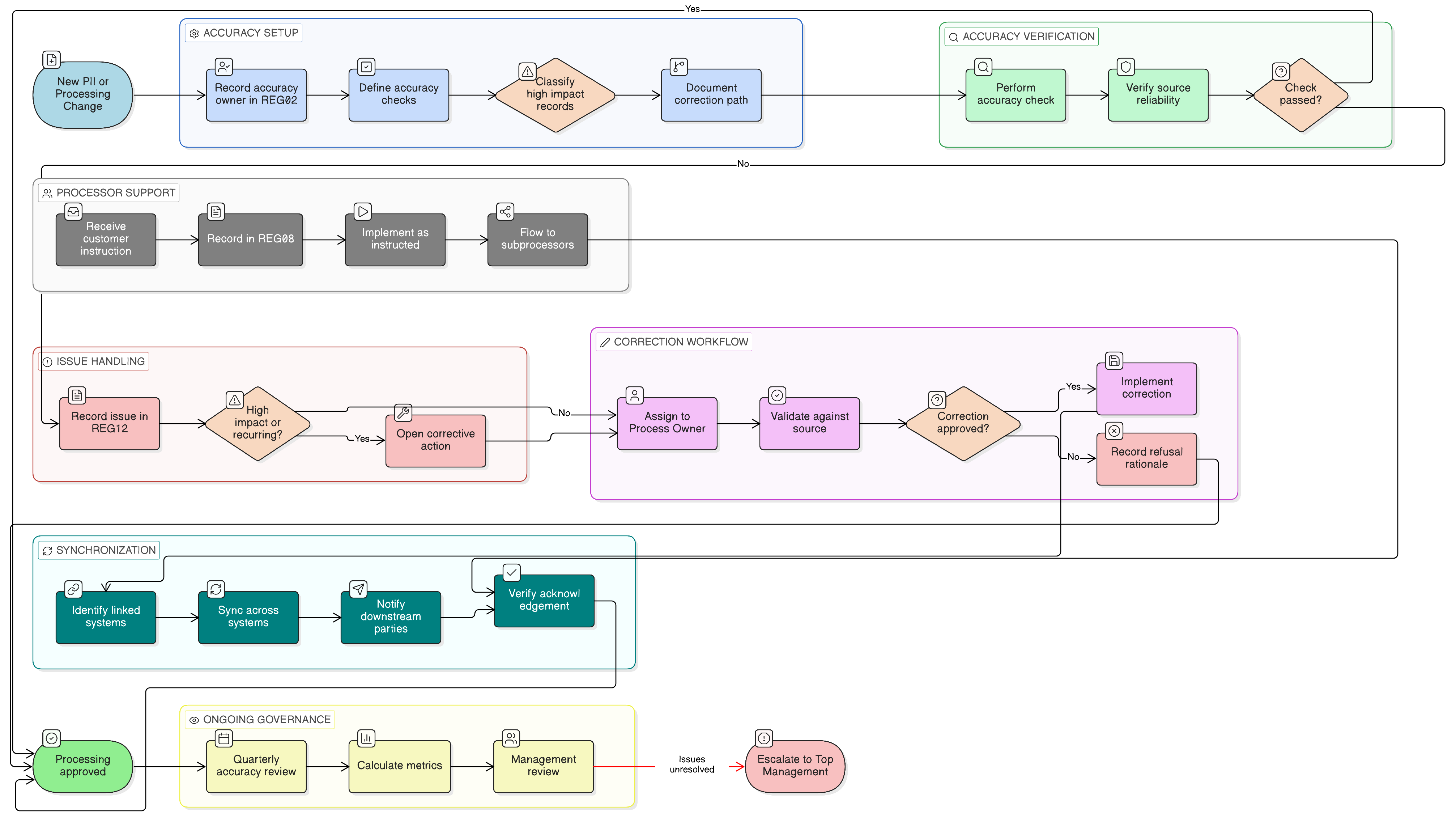
Policy Diagram

Process-flow diagram showing PII accuracy governance from REG02 ownership and high-impact classification through accuracy checks, REG06 correction validation, system implementation, REG08 downstream synchronization, REG12 monitoring, exceptions, nonconformity and management review.

Click diagram to enlarge (open in new tab for full size)

What's Inside

Accuracy ownership and REG02 requirements

High-impact record classification and review cadence

Accuracy checks and stale data review

Correction validation, implementation and closure workflow

Synchronization and downstream notification via REG08

Metrics, exceptions, nonconformity and corrective action in REG12

Framework Compliance

🛡️ Supported Standards & Frameworks

This product is aligned with the following compliance frameworks, with detailed clause and control mappings.

Framework Covered Clauses / Controls
ISO/IEC 27701:2025
Clause 7.5Clause 8.1Clause 9.1Clause 10.2Annex A.1.2.9Annex A.1.3.2Annex A.1.3.7Annex A.1.3.8Annex A.2.2.2Annex A.2.2.6Annex A.2.2.7Annex A.2.3.2
EU GDPR
Article 5(1)(d)Article 5(2)Article 16Article 19Article 24Article 28Article 30
ISO/IEC 29100:2020
Clause 5.7
ISO/IEC 29151:2022
Annex A.8

Related Policies

Processing Inventory and Lawful Basis Policy

REG02 processing inventory records are the foundation for accuracy ownership, sources, review frequency and high-impact classification.

Principal Rights Management Policy

Correction claims from PII principals are handled through REG06 and linked to this policy’s substantive accuracy review requirements.

Retention, Deletion and Disposal Policy

The policy routes erasure, retention restriction, deletion or disposal-only outcomes to the related workflow when correction is not sufficient.

Processor, Subprocessor and Third-Party Privacy Management Policy

Processor, subprocessor, recipient and data-sharing correction-support obligations are recorded and managed through REG08.

Security and Access Control Policy

Accuracy controls depend on system ownership and controlled implementation of corrections across source systems and linked applications.

PIMS Monitoring, Audit and Improvement Policy

Recurring, overdue or high-impact accuracy issues escalate into PIMS monitoring, audit, nonconformity and corrective action processes.

About Clarysec Policies - PII Accuracy and Quality Policy

Privacy governance fails when it is treated as a set of disconnected notices, forms, and legal statements. Effective ISO/IEC 27701 implementation requires a Privacy Information Management System that connects PII processing, lawful basis, controller and processor roles, privacy risk, DPIAs, evidence, monitoring, and continual improvement. This policy set is engineered as an operational privacy framework, not a generic documentation pack. It defines clear PIMS accountability across practical enterprise roles such as Top Management, the Privacy Lead / PIMS Manager, Process Owners, System Owners, Vendor / Procurement Owners, Information Security, and independent reviewers. Each requirement is written as a uniquely numbered, auditable clause and tied to defined evidence objects such as REG01, REG02, REG03, REG04, REG08, REG11, and REG12. The structure supports controller, joint controller, processor, and subprocessor contexts, helping organizations demonstrate accountable, risk-based, and evidence-driven management of PII processing across the full PIMS lifecycle.

Auditable Accuracy Controls

Uses numbered clauses and defined records to evidence ownership, checks, corrections and synchronization.

High-Impact Record Focus

Requires classification, review and escalation where inaccurate PII could materially affect a PII principal.

Role-Based Accountability

Assigns duties to Privacy Lead, Process Owners, System Owners, Vendor Owners, reviewers and Top Management.

Evidence-Driven Workflow

Connects REG02, REG06, REG08 and REG12 for correction, monitoring, exceptions and corrective action.

Frequently Asked Questions

Built for Leaders, By Leaders

This policy was authored by a security leader with 25+ years of experience deploying and auditing ISMS frameworks for global enterprises. It's designed not just to be a document, but a defensible framework that stands up to auditor scrutiny.

Authored by an expert holding:

MSc Cyber Security, Royal Holloway UoL CISM CISA ISO 27001:2022 Lead Auditor & Implementer CEH

Coverage & Topics

🏢 Target Departments

Privacy Legal Compliance IT Security DPO Office

🏷️ Topic Coverage

Privacy Information Management Personal Data Processing Data Subject Rights Management Records of Processing Controller and Processor Responsibilities Third Party Management Monitoring and Measurement
€69

One-time purchase

Instant download
Lifetime updates

This policy is 1 of 25 in the Complete ISO/IEC 27701 PIMS Pack

Save 52%

Get all 25 PIMS policies, full registers set and detailed implementation plan for €799, instead of €1,675 if purchased individually.

View Complete 27701 Pack →

PII Accuracy and Quality Policy

Product Details

Type: policy
Category: ISO 27701 PIMS Policy Pack
Standards: 4