Overview
This policy defines mandatory PIMS controls for child PII, child-facing services and child-accessible processing. It covers identification, notices, consent, parental authorization, DPIA routing, rights handling, processors, incidents, exceptions and audit-ready evidence through REG02, REG04, REG05, REG06, REG07, REG08, REG10 and REG12.
Enhanced Child PII Controls
Defines mandatory safeguards for child-facing, child-accessible and child-related PII processing within the PIMS scope.
Evidence-Driven Governance
Routes notices, consent, DPIAs, rights, processors, incidents and corrective actions through defined evidence objects.
Clear Role Accountability
Assigns responsibilities to privacy, business, system, vendor, security, incident response, audit and top management roles.
▾ Read Full Overview (click to expand)
Policy Diagram
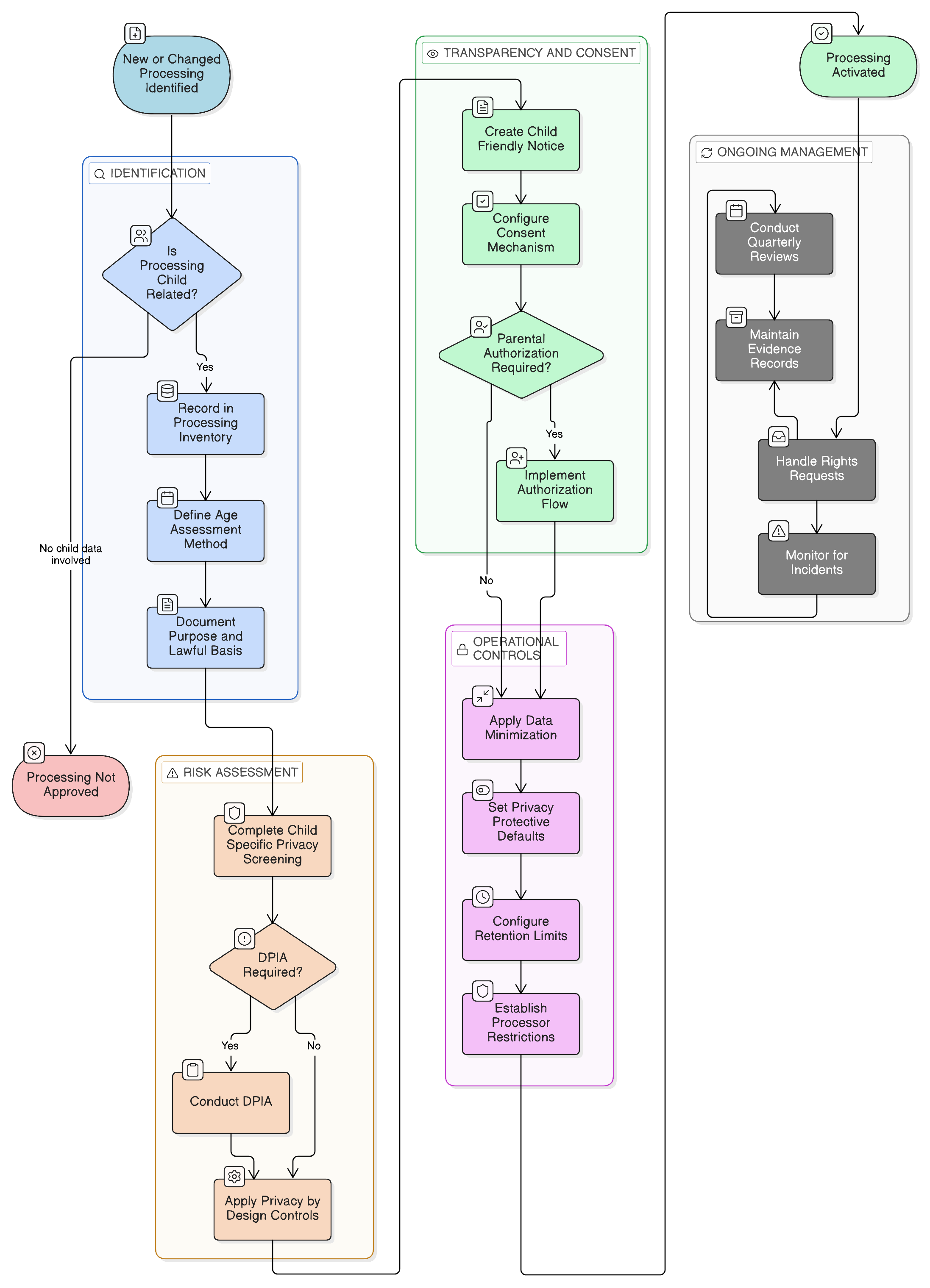
Click diagram to enlarge (open in new tab for full size)
What's Inside
Child-facing processing identification and authorization
Child-friendly transparency and notices
Consent, parental responsibility and withdrawal
Minimization, default settings and retention
Rights, DPIA, profiling and safety escalation
Disclosure, processor, subprocessor and evidence controls
Framework Compliance
🛡️ Supported Standards & Frameworks
This product is aligned with the following compliance frameworks, with detailed clause and control mappings.
| Framework | Covered Clauses / Controls |
|---|---|
| ISO/IEC 27701:2025 |
Clause 7.5Clause 8.1Clause 9.1Clause 10.2Annex A.1.2.2Annex A.1.2.3Annex A.1.2.4Annex A.1.2.5Annex A.1.2.6Annex A.1.2.9Annex A.1.2.7Annex A.1.2.8Annex A.1.3.2Annex A.1.3.3Annex A.1.3.4Annex A.1.3.5Annex A.1.3.6Annex A.1.3.7Annex A.1.3.10Annex A.1.3.11Annex A.1.4.2Annex A.1.4.3Annex A.1.4.5Annex A.1.4.8Annex A.1.4.9Annex A.1.5.4Annex A.1.5.5Annex A.2.2.2Annex A.2.2.3Annex A.2.2.6Annex A.2.2.7Annex A.2.3.2Annex A.2.5.4Annex A.2.5.5Annex A.2.5.6Annex A.3.14Annex A.3.25
|
| EU GDPR |
Article 5(1)(a)Article 5(1)(b)Article 5(1)(c)Article 5(1)(e)Article 5(2)Article 6Article 7Article 8Article 9Article 12Article 13Article 14Article 15Article 16Article 17Article 18Article 21Article 22Article 24Article 25Article 26Article 28Article 30Article 32Article 35Article 39
|
| ISO/IEC 29100:2020 |
Clause 5.1Clause 5.8Clause 5.9Clause 5.3Clause 5.4Clause 5.5Clause 5.6Clause 5.10Clause 5.11Clause 5.12
|
| ISO/IEC 29134:2020 |
Clause 5.1Clause 6.2Clause 6.3
|
| ISO/IEC 29151:2022 |
Annex A.3Annex A.4Annex A.5Annex A.7Annex A.10
|
| ISO/IEC TS 27560:2023 |
Clause 5.2Clause 5.3Clause 6.2Clause 6.4
|
Related Policies
Processing Inventory and Lawful Basis Policy
Child-facing status, purposes, lawful basis, data categories and retention references are recorded in the processing inventory.
Privacy Notice and Transparency Policy
Child-appropriate and parent or guardian notice content must be recorded, version-controlled and updated before relevant changes.
Consent and Preference Management Policy
The child privacy policy depends on consent, parental authorization, withdrawal routing and receipt evidence where applicable.
Principal Rights Management Policy
Requests from children, parents, guardians or authorized representatives are routed through the rights management process.
Privacy Risk Assessment and DPIA Policy
Child-specific privacy risk screening, DPIA decisions and high-risk processing reviews are core requirements of the policy.
Processor, Subprocessor and Third-Party Privacy Management Policy
Child PII processing by processors, subprocessors, suppliers and sharing recipients requires documented restrictions and assurance evidence.
About Clarysec Policies - Children's Privacy Policy
This Children's Privacy Policy is an operational PIMS policy for processing involving children, child-facing services, services likely to be accessed by children, and other child PII requiring enhanced safeguards. It defines accountability across roles including Top Management, the Privacy Lead / PIMS Manager, Process Owners, System Owners, Vendor / Procurement Owners, Information Security, Incident Response and Internal Audit / Compliance Reviewers. The policy requires evidence to be maintained in canonical evidence objects such as REG02, REG04, REG05, REG06, REG07, REG08, REG10 and REG12, rather than in a separate child privacy register.
Child-Facing Scope
Covers child-facing services, child-accessible processing and activities where child PII needs enhanced safeguards.
Canonical Evidence
Uses REG02, REG04, REG05, REG06, REG07, REG08, REG10 and REG12 instead of a separate child privacy register.
Role-Based Ownership
Assigns specific duties to privacy, business, system, vendor, security, incident response, audit and top management roles.
Quarterly Oversight
Requires quarterly reviews and measures for child privacy evidence, DPIAs, issues and processor or sharing gaps.
Frequently Asked Questions
Built for Leaders, By Leaders
This policy was authored by a security leader with 25+ years of experience deploying and auditing ISMS frameworks for global enterprises. It's designed not just to be a document, but a defensible framework that stands up to auditor scrutiny.
Authored by an expert holding:
Coverage & Topics
🏢 Target Departments
🏷️ Topic Coverage
This policy is 1 of 25 in the Complete ISO/IEC 27701 PIMS Pack
Save 52%Get all 25 PIMS policies, full registers set and detailed implementation plan for €799, instead of €1,675 if purchased individually.
View Complete 27701 Pack →