Overview
This policy defines how PII principal rights requests are received, verified, evaluated, fulfilled, refused, extended, closed and evidenced. It covers controller, joint controller, processor and subprocessor contexts, using REG06 as the core rights request record.
Audit-Ready Rights Handling
Defines how rights requests are logged, evaluated, fulfilled, refused, extended, closed and evidenced in REG06.
Controller and Processor Coverage
Applies across controller, joint controller, processor and subprocessor contexts with documented instructions and responsibilities.
Secure Fulfilment Workflow
Requires identity verification, secure response delivery, response package checks and protection of rights request records.
▾ Read Full Overview (click to expand)
Policy Diagram
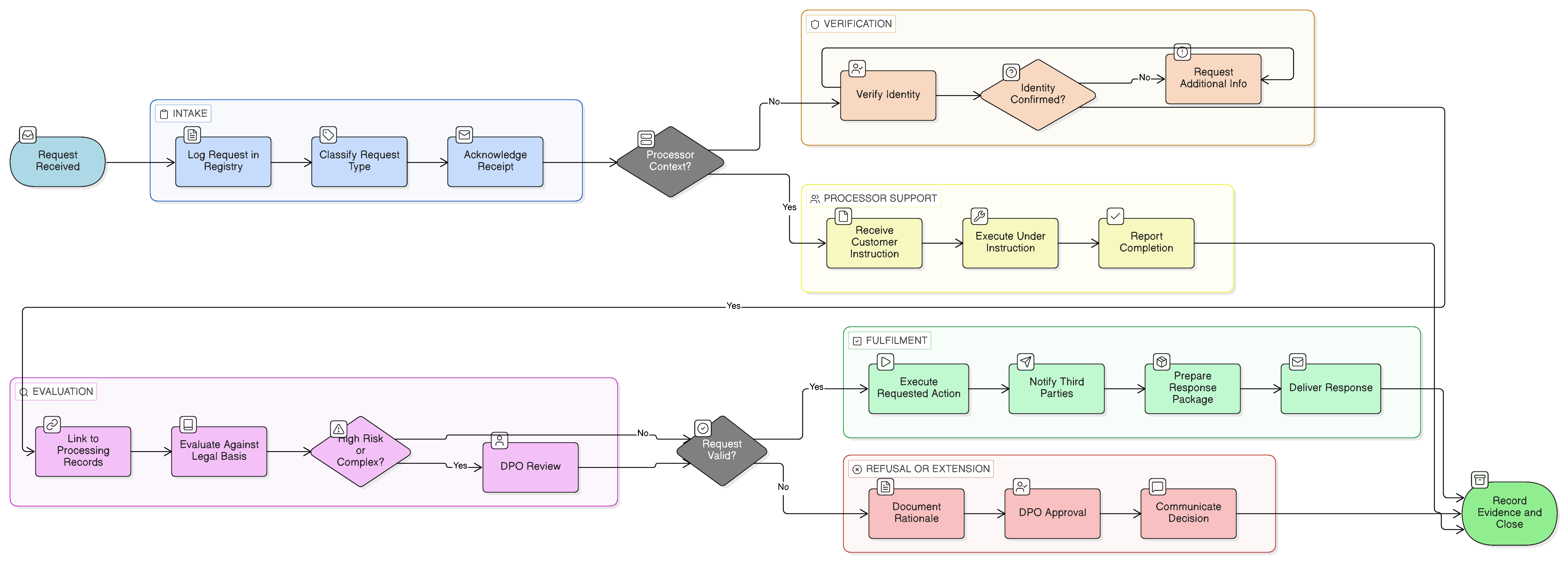
Click diagram to enlarge (open in new tab for full size)
What's Inside
Rights Request Intake and REG06 Logging
Identity Verification and Request Evaluation
Access, Rectification, Erasure, Restriction, Portability and Objection
Refusal, Extension and Closure Evidence
Processor, Subprocessor and Third-Party Cooperation
Metrics, Exceptions and Corrective Action
Framework Compliance
🛡️ Supported Standards & Frameworks
This product is aligned with the following compliance frameworks, with detailed clause and control mappings.
| Framework | Covered Clauses / Controls |
|---|---|
| ISO/IEC 27701:2025 |
Clause 7.5Clause 8.1Clause 9.1Clause 10.2Annex A.1.3.2Annex A.1.3.6Annex A.1.3.7Annex A.1.3.8Annex A.1.3.9Annex A.1.3.10Annex A.1.3.11Annex A.1.2.9Annex A.2.2.2Annex A.2.2.6Annex A.2.2.7Annex A.2.3.2Annex A.3.14
|
| EU GDPR |
Article 5(1)(a)Article 5(2)Article 11Article 12Article 15Article 16Article 17Article 18Article 19Article 20Article 21Article 22Article 24Article 26Article 28Article 30Article 32Article 39
|
| ISO/IEC 29100:2020 |
Clause 5.8Clause 5.9Clause 5.10Clause 5.12
|
| ISO/IEC 29151:2022 |
Annex A.10
|
Related Policies
Privacy Information Management System Policy
Provides the overarching PIMS governance structure that supports rights request management.
Processing Inventory and Lawful Basis Policy
Rights requests must be linked to processing activities, purposes, categories, recipients and retention constraints.
Consent and Preference Management Policy
Consent withdrawal and preference-change requests received through the rights process are routed to REG05.
Retention, Deletion and Disposal Policy
Approved erasure actions are completed through the applicable retention and deletion process.
Processor, Subprocessor and Third-Party Privacy Management Policy
The policy relies on third-party, processor and subprocessor coordination for rights-support actions and evidence.
Incident and Breach Management Policy
Rights requests that indicate a possible PII incident or breach must be escalated to REG10.
About Clarysec Policies - PII Principal Rights Management Policy
The PII Principal Rights Management Policy defines an operational workflow for handling PII principal rights requests across controller, joint controller, processor and subprocessor contexts. It assigns accountability to roles including the Privacy Lead / PIMS Manager, Process Owner / Business Owner, System Owner / Application Owner, Data Protection Officer / Privacy Advisor, Information Security Lead, Vendor / Procurement Owner, Incident Response Coordinator, Internal Audit / Compliance Reviewer and Top Management. The policy requires documented intake, identity verification, evaluation, fulfilment, refusal, extension, closure, monitoring, exception handling and corrective action, with evidence captured through records such as REG02, REG03, REG04, REG05, REG06, REG07, REG08, REG10, REG11 and REG12.
Defined Request Lifecycle
Covers intake, validation, evaluation, fulfilment, refusal, extension, closure and monitoring.
Verification Before Disclosure
Requires identity or representative authority checks before PII disclosure or requested changes.
Third-Party Coordination
Sets requirements for processor, subprocessor, joint-controller and recipient support through REG08.
Measured Control Performance
Requires monthly and quarterly monitoring of rights request status, timeliness and recurring themes.
Frequently Asked Questions
Built for Leaders, By Leaders
This policy was authored by a security leader with 25+ years of experience deploying and auditing ISMS frameworks for global enterprises. It's designed not just to be a document, but a defensible framework that stands up to auditor scrutiny.
Authored by an expert holding:
Coverage & Topics
🏢 Target Departments
🏷️ Topic Coverage
This policy is 1 of 25 in the Complete ISO/IEC 27701 PIMS Pack
Save 52%Get all 25 PIMS policies, full registers set and detailed implementation plan for €799, instead of €1,675 if purchased individually.
View Complete 27701 Pack →