Overview
A complete operational PIMS policy set supported by REG01–REG12 registers and a clause-level implementation plan. It connects privacy governance, risk, DPIA, rights, suppliers, transfers, incidents, training, evidence, audit and continual improvement into one auditable framework.
Full PIMS Policy Framework
A complete privacy management policy set covering governance, risk, DPIA, rights, suppliers, incidents, security, evidence and improvement.
Register-Based Implementation
Policies are tied to canonical evidence objects REG01 through REG12 to support traceability, accountability and implementation tracking.
Audit-Ready Operating Model
The framework connects clauses, roles, registers, evidence, monitoring, corrective action and management review into one PIMS lifecycle.
▾ Read Full Overview (click to expand)
Policy Diagram
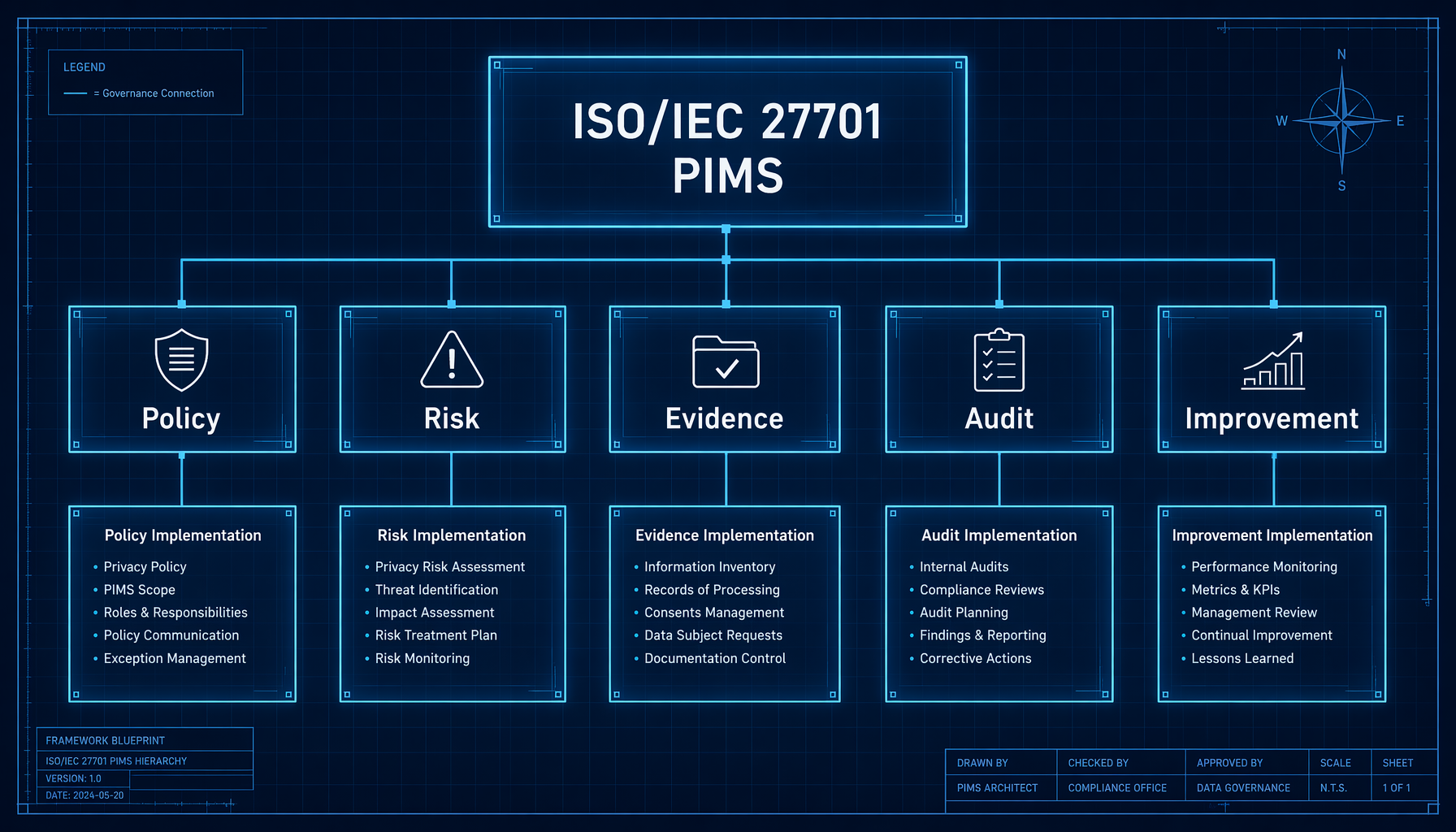
Click diagram to enlarge (open in new tab for full size)
What's Inside
Full ISO/IEC 27701 PIMS policy set
Canonical registers REG01 through REG12
Implementation plan and clause-level action tracking
Role-based ownership and accountability model
Compliance mappings to privacy, security and audit standards
Monitoring, audit, nonconformity and continual improvement workflow
Framework Compliance
🛡️ Supported Standards & Frameworks
This product is aligned with the following compliance frameworks, with detailed clause and control mappings.
| Framework | Covered Clauses / Controls |
|---|---|
| ISO/IEC 27701:2025 |
Clause 4.1Clause 4.2Clause 4.3Clause 4.4Clause 5.1Clause 5.2Clause 5.3Clause 6.1.1Clause 6.1.2Clause 6.1.3Clause 6.2Clause 6.3Clause 7.1Clause 7.2Clause 7.3Clause 7.4Clause 7.5Clause 8.1Clause 8.2Clause 8.3Clause 9.1Clause 9.2Clause 9.3Clause 10.1Clause 10.2Annex A.1.2.2Annex A.1.2.3Annex A.1.2.6Annex A.1.2.7Annex A.1.2.8Annex A.1.2.9Annex A.1.3.2Annex A.1.3.3Annex A.1.3.4Annex A.1.3.6Annex A.1.3.7Annex A.1.3.8Annex A.1.3.9Annex A.1.3.10Annex A.1.3.11Annex A.1.4.2Annex A.1.4.3Annex A.1.4.5Annex A.1.4.6Annex A.1.4.7Annex A.1.4.8Annex A.1.4.9Annex A.2.2.2Annex A.2.2.3Annex A.2.2.5Annex A.2.2.6Annex A.2.2.7Annex A.2.3.2Annex A.2.4.3Annex A.2.5.4Annex A.2.5.5Annex A.2.5.6Annex A.2.5.7Annex A.2.5.8Annex A.2.5.9Annex A.3.8Annex A.3.9Annex A.3.11Annex A.3.12Annex A.3.13Annex A.3.14Annex A.3.15Annex A.3.16Annex A.3.17Annex A.3.22Annex A.3.23Annex A.3.25Annex A.3.26Annex A.3.28Annex A.3.29
|
| EU GDPR |
Article 5(1)(a)Article 5(1)(f)Article 5(2)Article 11Article 12Article 15Article 16Article 17Article 18Article 19Article 20Article 21Article 22Article 24Article 26Article 28Article 30Article 32Article 33Article 34Article 39Article 47Article 48Article 49
|
| ISO/IEC 29100:2020 |
Clause 4.7Clause 5.1Clause 5.6Clause 5.8Clause 5.9Clause 5.10Clause 5.11Clause 5.12
|
| ISO/IEC 29151:2022 |
Clause 4.1Clause 4.2Clause 9.4.2Clause 9.4.3Clause 9.4.4Clause 9.4.5Clause 10.1.2Clause 10.1.3Clause 12.1.5Clause 15.1.2Clause 15.2.2Clause 15.2.3Clause 16.1.2Clause 16.1.3Clause 18.1.4Clause 18.1.5Clause 18.2.2Clause 18.2.3Clause 18.2.4Annex A.2Annex A.3Annex A.4Annex A.5Annex A.7Annex A.8Annex A.10
|
| ISO/IEC 27001:2022 | |
| ISO/IEC 27002:2022 | |
| ISO/IEC 29134:2020 |
Clause 1Clause 5.1Clause 6.2Clause 6.3
|
| ISO/IEC 27557:2022 |
Clause 4Clause 5.2Clause 5.3Clause 5.4.1Clause 6.4Clause 6.5Clause 6.6Clause 6.7
|
| ISO/IEC 27035-1:2023 |
Clause 5.2
|
| ISO/IEC 27035-3:2020 |
Clause 7Clause 8Clause 9Clause 10Clause 11Clause 12
|
Related Policies
PII Principal Rights Management Policy
Defines the operating model for rights request intake, verification, response, escalation, refusal, extension and closure evidence.
Privacy Information Management System Policy
Defines the overall PIMS scope, governance structure, objectives, register model and accountability foundation for the full policy set.
Privacy Roles, Responsibilities and Accountability Policy
Establishes the role-based accountability model used across policy implementation, evidence ownership, review and approval activities.
PII Processing Inventory and Lawful Basis Policy
Provides the processing inventory and lawful-basis evidence structure that underpins privacy governance, risk assessment and compliance records.
Privacy Notice and Transparency Policy
Connects processing records, notices, transparency obligations and PII principal communications to the wider PIMS evidence model.
Consent and Preference Management Policy
Supports consent, preference, withdrawal and authorization evidence where processing depends on consent or preference-based controls.
Privacy Risk Assessment and DPIA Policy
Provides the privacy risk and DPIA method used to assess new or changed processing and drive treatment decisions.
Privacy by Design and Default Policy
Links privacy requirements to design, default settings, system change, operational readiness and go-live control evidence.
PII Collection, Use, Disclosure and Sharing Policy
Controls approved collection, use, disclosure, sharing and transfer-routing decisions across controller and processor contexts.
PII Retention, Deletion and Disposal Policy
Defines retention, deletion, disposal, final disposition and lifecycle evidence requirements for PII processing activities.
PII Accuracy and Quality Policy
Supports accuracy, correction, quality review and data-quality evidence where PII quality affects processing or rights outcomes.
Processor, Subprocessor and Third-Party Privacy Management Policy
Defines supplier, processor, subprocessor, third-party, due diligence, contract, assurance, monitoring and exit governance.
International PII Transfer Policy
Provides the transfer governance model for international PII transfers, safeguards, mechanisms, onward transfers and exceptions.
PII Security and Access Control Policy
Connects privacy governance with PII-specific security, access control, authentication, logging, cryptographic and technical protection evidence.
PII Incident and Breach Management Policy
Defines privacy incident and breach intake, assessment, escalation, notification, evidence, lessons learned and closure requirements.
Financial Sector PII Incident and Breach Management Policy
Provides a financial-sector incident and breach variant for regulated contexts where additional operational or regulatory obligations apply.
Privacy Training, Awareness and Competence Policy
Defines privacy training, awareness, competence, completion evidence and role-based knowledge requirements for PIMS operation.
PIMS Documented Information and Evidence Management Policy
Controls PIMS documented information, policy records, approvals, versioning, translations, evidence integrity and retrieval.
PIMS Monitoring, Audit and Improvement Policy
Defines monitoring, metrics, internal audit, management review, nonconformity, corrective action and continual improvement for the PIMS.
Employee Privacy Policy
Extends the PIMS framework to employee and HR processing, workforce notices, monitoring, HR suppliers and employee privacy evidence.
Children's Privacy Policy
Extends the PIMS framework to child-related processing, parental authorization, child rights, safeguards and child privacy evidence.
AI and Automated Decision-Making Privacy Policy
Controls AI, profiling and automated decision-making privacy risks, transparency, rights, DPIA routing and processing evidence.
Marketing Privacy and Cookies Policy
Extends the PIMS framework to marketing, cookies, consent, preferences, transparency, tracking and related processing evidence.
Cloud PII Processor Policy
Supports cloud processor governance where cloud-based PII processing, customer instructions, supplier obligations or regulated cloud requirements are in scope.
CCTV and Physical Monitoring Privacy Policy
Extends the PIMS framework to CCTV and physical monitoring activities, including transparency, lawful basis, access, retention and monitoring evidence.
About Clarysec Policies - Complete ISO/IEC 27701 PIMS pack
This full policy set is structured as an operational Privacy Information Management System rather than a static documentation pack. It connects policy clauses to assigned roles, canonical registers, implementation tasks, evidence requirements and review cycles. The framework uses REG01 through REG12 as the evidence backbone for scope, processing inventory, control applicability, privacy risk and DPIA, consent, rights, accuracy, supplier governance, transfers, incidents, training, documented information, monitoring, audit and improvement. It supports controller, joint controller, processor and subprocessor operating contexts and assigns responsibilities across Top Management, the Privacy Lead / PIMS Manager, Data Protection Officer / Privacy Advisor, Process Owners, System Owners, Vendor / Procurement Owners, Information Security, Incident Response and Internal Audit. The implementation plan turns the policy clauses into trackable actions with owners, dates and completion status, while the register model preserves audit-ready evidence for certification readiness, assurance reviews and continual improvement.
Policy-to-Register Traceability
Each policy area links to REG01–REG12 so obligations can be evidenced through canonical records instead of disconnected files.
Role-Based Accountability
Responsibilities are assigned to operational roles including privacy, security, process, system, procurement, incident and audit owners.
Implementation Tracking
Clause-level actions can be tracked by owner, status, due date, evidence object and completion notes.
Evidence-Driven Governance
The framework supports audit readiness through evidence records, review cycles, corrective actions and management review inputs.
Multi-Context PIMS Coverage
The set supports controller, joint controller, processor and subprocessor privacy management contexts.
Frequently Asked Questions
Built for Leaders, By Leaders
This policy was authored by a security leader with 25+ years of experience deploying and auditing ISMS frameworks for global enterprises. It's designed not just to be a document, but a defensible framework that stands up to auditor scrutiny.