Overview
This policy embeds privacy by design and default into PII projects, changes, procurement and go-live decisions. It requires purpose-based minimization, privacy-default configuration, risk and DPIA screening linkage, supplier design evidence, and auditable records in REG02, REG04, REG08 and REG12.
Design Before Go-Live
Requires privacy design reviews, minimization evidence and default settings before production release or operational launch.
Audit-Ready Evidence
Links privacy design decisions to REG02, REG04, REG08 and REG12 so records, gaps, exceptions and actions remain traceable.
Clear Role Accountability
Defines responsibilities for privacy, process, system, security, procurement, audit and top management roles across design gates.
▾ Read Full Overview (click to expand)
Policy Diagram
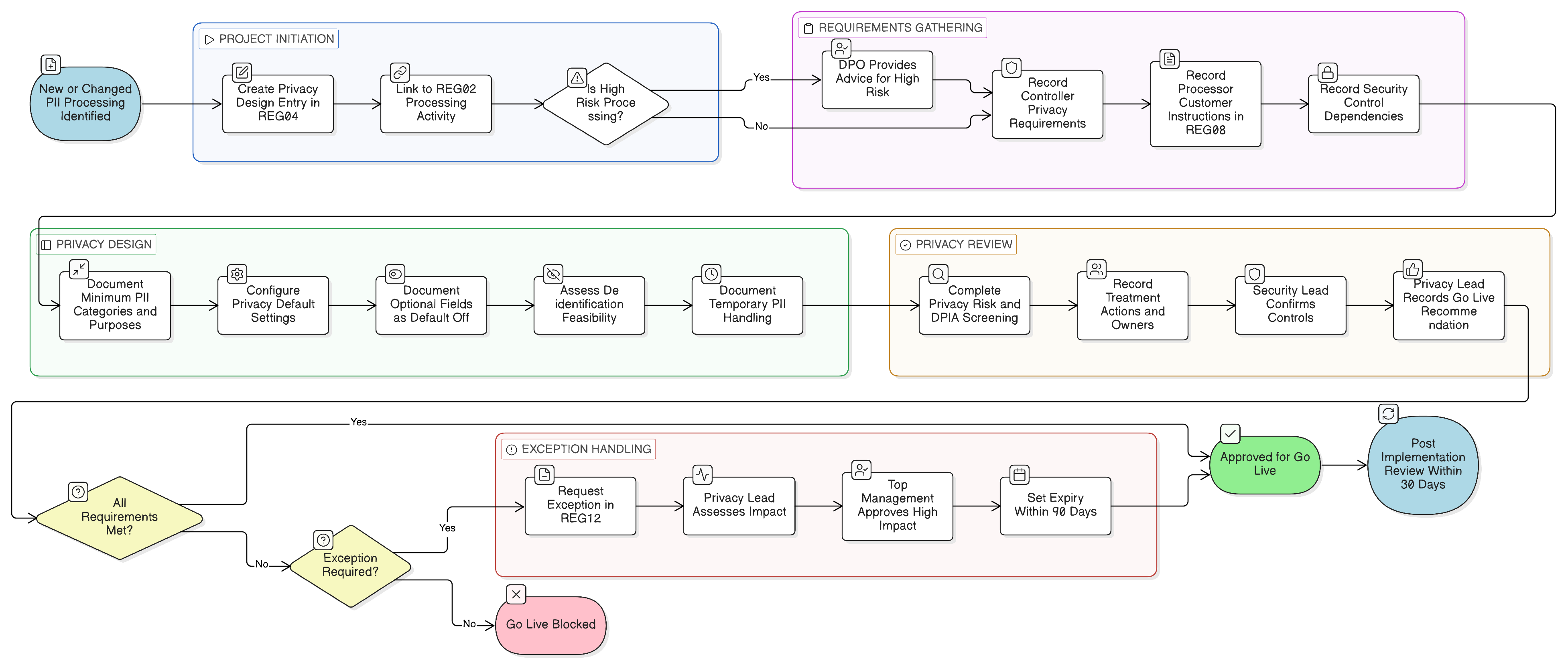
Click diagram to enlarge (open in new tab for full size)
What's Inside
Privacy requirements at project initiation
Purpose, minimization and default-setting design controls
Privacy design review before go-live
Change-triggered privacy design review
Procurement privacy-by-design checks
Privacy risk, DPIA screening and corrective action linkage
Framework Compliance
🛡️ Supported Standards & Frameworks
This product is aligned with the following compliance frameworks, with detailed clause and control mappings.
| Framework | Covered Clauses / Controls |
|---|---|
| ISO/IEC 27701:2025 |
Clause 6.1.2Clause 6.1.3Clause 6.3Clause 8.1Clause 7.5Clause 9.1Clause 10.2Annex A.1.2.2Annex A.1.2.6Annex A.1.2.9Annex A.1.4.2Annex A.1.4.3Annex A.1.4.4Annex A.1.4.5Annex A.1.4.6Annex A.1.4.7Annex A.2.2.2Annex A.2.2.6Annex A.2.2.7Annex A.2.4.2Annex A.2.4.3Annex A.2.4.4Annex A.3.27Annex A.3.29
|
| EU GDPR |
Article 5(1)(b)Article 5(1)(c)Article 5(2)Article 24Article 25Article 28Article 30Article 35
|
| ISO/IEC 29100:2020 |
Clause 4.7Clause 5.3Clause 5.4Clause 5.5Clause 5.6Clause 5.7Clause 5.10Clause 5.12
|
| ISO/IEC 29151:2022 |
Annex A.3Annex A.4Annex A.5Annex A.7Annex A.8
|
Related Policies
Processing Inventory and Lawful Basis Policy
Privacy design entries must link to REG02 processing activities, purposes and processing-record updates.
Privacy Risk Assessment and DPIA Policy
This policy triggers privacy risk and DPIA screening while leaving the assessment methodology to PII07.
Collection, Use, Disclosure and Sharing Policy
Design controls must limit collection, use, disclosure and sharing to documented purposes and minimum PII needs.
Retention, Deletion and Disposal Policy
Privacy design dependencies for retention, deletion and temporary PII artifacts are routed to the related evidence path.
Processor, Subprocessor and Third-Party Privacy Management Policy
Procurement and third-party privacy-by-design checks rely on supplier, processor and subprocessor governance evidence.
Security and Access Control Policy
PII security-control dependencies must be recorded as inputs supporting privacy design and go-live decisions.
About Clarysec Policies - Privacy by Design and Default Policy
The Privacy by Design and Default Policy operationalizes privacy requirements before PII processing begins or materially changes. It requires privacy design entries, processing-record linkage, minimization decisions, default privacy settings, procurement checks, risk and DPIA screening linkage, go-live review, exceptions, corrective action and monitoring evidence. The policy applies across controller, joint controller, processor and subprocessor contexts and assigns clear responsibilities to Top Management, the Privacy Lead / PIMS Manager, Process Owners, System Owners, Vendor / Procurement Owners, Information Security, DPO / Privacy Advisor roles and audit or compliance reviewers.
Design Scope
Covers projects, products, services, systems, applications, integrations, procurement and business process changes involving PII.
Default Minimization
Requires minimum PII collection and processing settings before go-live and records evidence in REG04.
Risk Linkage
Connects privacy design review with privacy risk and DPIA screening without duplicating the PII07 methodology.
Procurement Checks
Requires REG08 evidence for supplier, processor, subprocessor, SaaS and externally hosted system design obligations.
Escalation Control
Routes missing controls, unresolved gaps, exceptions and unauthorized go-live issues through REG12.
Frequently Asked Questions
Built for Leaders, By Leaders
This policy was authored by a security leader with 25+ years of experience deploying and auditing ISMS frameworks for global enterprises. It's designed not just to be a document, but a defensible framework that stands up to auditor scrutiny.
Authored by an expert holding:
Coverage & Topics
🏢 Target Departments
🏷️ Topic Coverage
This policy is 1 of 25 in the Complete ISO/IEC 27701 PIMS Pack
Save 52%Get all 25 PIMS policies, full registers set and detailed implementation plan for €799, instead of €1,675 if purchased individually.
View Complete 27701 Pack →