Overview
This policy defines privacy controls for CCTV, visitor monitoring, physical access logs, and related monitoring PII. It requires approved purposes, signage, risk review, access restrictions, retention and deletion controls, disclosure governance, rights routing, incident escalation, and PIMS evidence management.
Purposeful Monitoring Controls
Requires CCTV and physical monitoring activities to be defined, approved, and documented before activation.
Transparent Notice Evidence
Links monitoring signage and just-in-time notices to approved processing purposes and PIMS evidence records.
Access and Retention Governance
Controls viewing, export, disclosure, deletion, retention holds, and privileged access review for monitoring PII.
▾ Read Full Overview (click to expand)
Policy Diagram
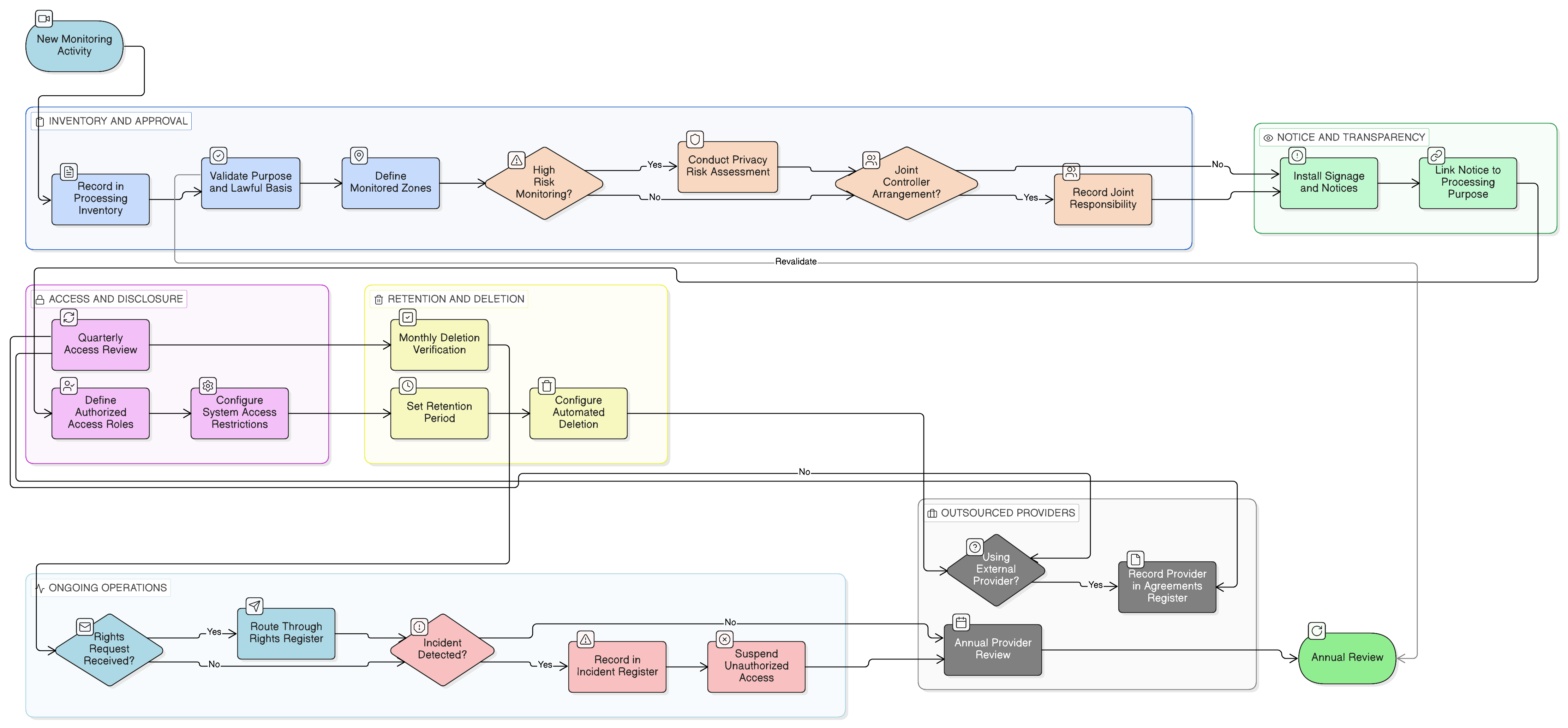
Click diagram to enlarge (open in new tab for full size)
What's Inside
CCTV and physical monitoring scope
Monitoring inventory, purpose, and approval
Notice, signage, and transparency evidence
Access, viewing, export, and disclosure controls
Retention, deletion, and extracted copy handling
Rights request routing, incident escalation, and provider oversight
Framework Compliance
🛡️ Supported Standards & Frameworks
This product is aligned with the following compliance frameworks, with detailed clause and control mappings.
| Framework | Covered Clauses / Controls |
|---|---|
| ISO/IEC 27701:2025 |
Clause 7.5Clause 8.1Clause 9.1Clause 10.2Annex A.1.2.2Annex A.1.2.3Annex A.1.2.6Annex A.1.2.9Annex A.1.2.7Annex A.1.2.8Annex A.1.3.2Annex A.1.3.6Annex A.1.3.7Annex A.1.3.10Annex A.1.4.2Annex A.1.4.3Annex A.1.4.5Annex A.1.4.8Annex A.1.4.9Annex A.1.5.4Annex A.1.5.5Annex A.2.2.2Annex A.2.2.3Annex A.2.2.6Annex A.2.2.7Annex A.2.3.2Annex A.2.5.4Annex A.2.5.5Annex A.2.5.6Annex A.3.14Annex A.3.25
|
| EU GDPR |
Article 5(1)(a)Article 5(1)(b)Article 5(1)(c)Article 5(1)(e)Article 5(2)Article 6Article 12Article 13Article 14Article 15Article 16Article 17Article 18Article 21Article 24Article 26Article 28Article 30Article 32Article 35Article 39
|
| ISO/IEC 29100:2020 |
Clause 5.3Clause 5.4Clause 5.5Clause 5.6Clause 5.8Clause 5.9Clause 5.10Clause 5.11Clause 5.12
|
| ISO/IEC 29134:2020 |
Clause 5.1Clause 6.2
|
| ISO/IEC 29151:2022 |
Annex A.3Annex A.4Annex A.5Annex A.7Annex A.10Clause 9.2.3Clause 9.4.2Clause 11.1.3
|
| ISO/IEC 27002:2022 |
Related Policies
Processing Inventory and Lawful Basis Policy
Monitoring activities must be recorded in REG02 with purpose, lawful basis, location, PII categories, retention, access, and disclosure details.
Privacy Notice and Transparency Policy
CCTV and physical monitoring require signage, just-in-time notice evidence, and linkage between notices and processing purposes.
Principal Rights Management Policy
Requests involving monitoring footage, visitor data, or physical access logs are routed through REG06 under the rights process.
Privacy Risk Assessment and DPIA Policy
Higher-risk monitoring triggers REG04 privacy risk decisions and, where applicable, DPIA-related review before activation.
Retention, Deletion and Disposal Policy
Monitoring repositories require defined retention, routine deletion or overwriting, deletion evidence, and controlled retention holds.
Security and Access Control Policy
Monitoring systems depend on approved access roles, access restrictions, privileged access reviews, logging, and containment actions.
About Clarysec Policies - CCTV and Physical Monitoring Privacy Policy
This policy provides an operational privacy framework for CCTV and physical monitoring activities that process PII. It defines how monitoring purposes, lawful basis, locations, notice evidence, access roles, disclosure boundaries, retention periods, deletion controls, provider evidence, incident escalation, and review activity are documented across REG02, REG04, REG06, REG07, REG08, REG10, and REG12. The policy applies to controller activities for the organization’s own premises and to processor or subprocessor support activities involving customer monitoring footage, visitor records, or physical access logs.
Defined Monitoring Scope
Covers CCTV, visitor monitoring, access logs, guard records, premises systems, and related monitoring PII.
Risk-Based Activation
Requires REG04 review before high-risk, non-obvious, audio, biometric, analytics, or sensitive monitoring starts.
Controller and Processor Use
Applies to own-premises monitoring and customer-instructed support for footage, visitor data, and access logs.
Auditable Evidence Model
Uses REG02, REG04, REG06, REG07, REG08, REG10, and REG12 for records, review, incidents, and oversight.
Frequently Asked Questions
Built for Leaders, By Leaders
This policy was authored by a security leader with 25+ years of experience deploying and auditing ISMS frameworks for global enterprises. It's designed not just to be a document, but a defensible framework that stands up to auditor scrutiny.
Authored by an expert holding:
Coverage & Topics
🏢 Target Departments
🏷️ Topic Coverage
This policy is 1 of 25 in the Complete ISO/IEC 27701 PIMS Pack
Save 52%Get all 25 PIMS policies, full registers set and detailed implementation plan for €799, instead of €1,675 if purchased individually.
View Complete 27701 Pack →